
“Educational” is one of the most overused words on a toy box. It gets stuck on anything with letters, numbers, or a vaguely learning-shaped premise, whether or not it actually builds a skill. If you’re trying to choose educational toys for toddlers that genuinely earn the label, it helps to know what separates real developmental value from a marketing sticker.
It should build a specific skill, not just contain information. A toy covered in letters isn’t automatically educational — a toy is educational when the activity itself exercises a skill. Threading a bead, matching a shape, placing a magnetic piece precisely: these build fine motor control and hand-eye coordination through the doing, not through passive exposure to facts on a box.
Fine motor skills matter more than they get credit for. Long before a child is reading or counting, the small, repeated movements of picking up, placing, and manipulating objects are laying the groundwork for writing, dressing, and independence more broadly. Toys that ask a toddler to grip, align, and place something precisely are quietly doing more developmental work than toys that simply light up in response to a button press.
The best educational toys don’t feel like lessons. Genuine learning at this age happens through absorption, not instruction — a child figuring out which piece fits where, or working out an answer on a quiz card, is learning far more actively than one being told an answer. If a toy needs an adult narrating “this teaches maths” to justify itself, that’s often a sign the learning isn’t built into the play itself.
Open-ended toys teach more over time than single-purpose ones. A toy with one correct outcome gets solved once and loses its educational value immediately after. A toy that can be approached differently — sorted today, built into a scene tomorrow, quizzed on the next day — keeps offering something new to figure out, which means the learning compounds rather than ending.
Look for toys that combine more than one type of skill. A toy that only does one thing teaches one thing. Combining fine motor practice with early vocabulary, or problem-solving with imaginative play, gives a child several different ways to develop from the same object, which is a more efficient use of both playtime and the shelf space.
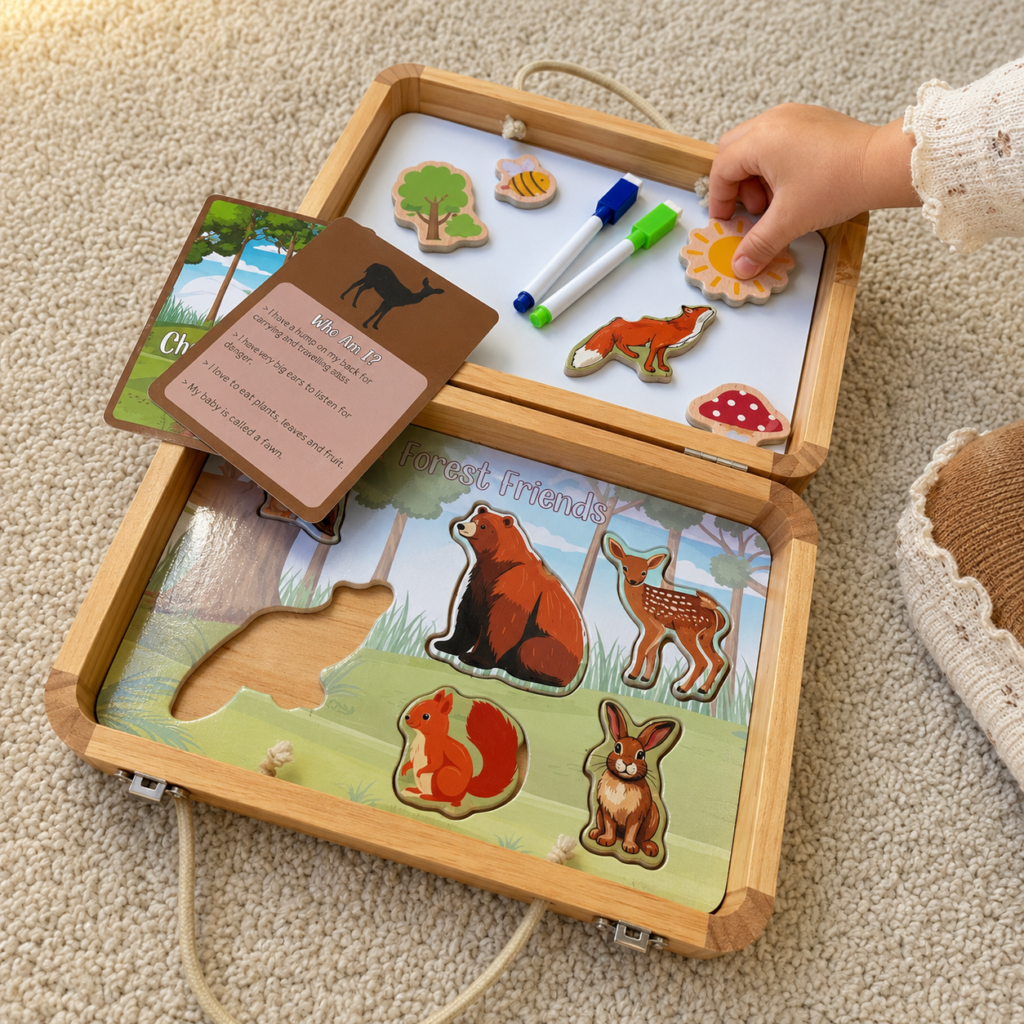
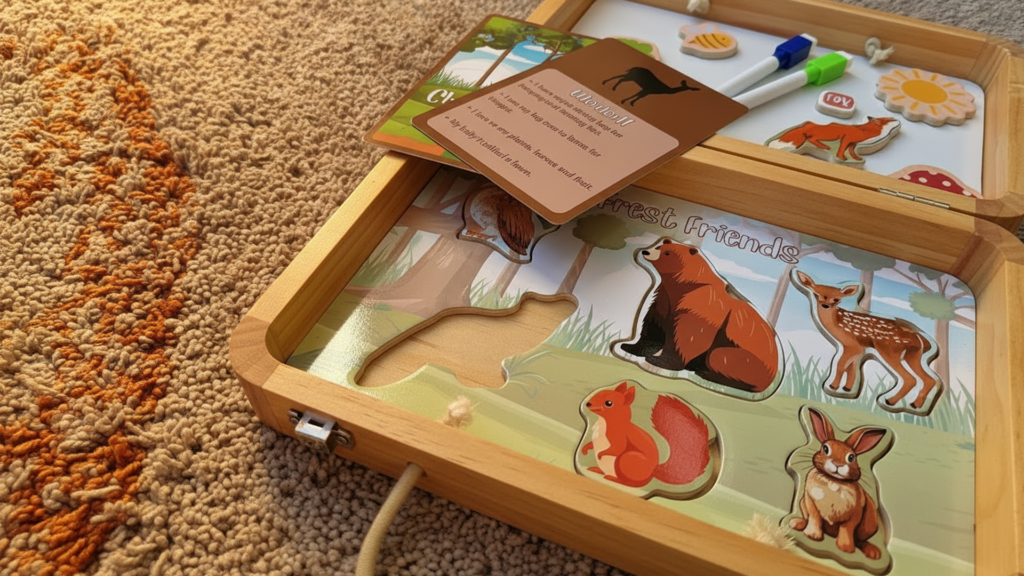
Our own Forest Friends activity box was designed with this in mind. The magnetic animals and whiteboard build fine motor control and hand-eye coordination through placing and drawing; the animal quiz cards introduce early vocabulary and simple facts in a low-pressure, game-like way; and because there’s more than one activity in the box, a child moves between different kinds of learning without it ever feeling like a lesson.
Whatever educational toys for toddlers you’re weighing up, the same test applies: does the activity build a real skill, or is the word “educational” just doing the work the toy itself isn’t?
Frequently asked questions
What age should educational toys start being used?
Educational play can start from infancy, but the type of toy should match the stage. For toddlers around age 2–3, simple cause-and-effect and sorting activities work well; from around age 3 upward, toys that involve more sustained fine motor tasks, matching, and early problem-solving become appropriate.
Are educational toys better than regular toys?
Not necessarily — most open-ended play has developmental value, whether or not a toy is marketed as “educational.” The label is most useful when it points to a toy that genuinely builds a specific skill through the activity itself, rather than simply being a marketing term.
What skills do educational toys for toddlers usually support?
Common areas include fine motor control, hand-eye coordination, early problem-solving, language and vocabulary, and independent concentration. The best toys tend to combine more than one of these rather than focusing on just one.
How do I know if a toy is genuinely educational or just labelled that way?
Look at what the child actually has to do to play with it. If the activity itself requires thinking, coordination, or problem-solving, it’s likely building a real skill. If the “educational” element is just decoration — letters or numbers printed on a surface with no interaction required — the label is doing more work than the toy.
Here’s What Else We Make…
Free Printables for Calm Play at Home
If toy rotation got you thinking about creating a more intentional play space, our free printable library is a good next step. Posters, activity sheets and learning resources designed for the kind of calm, focused play we’ve been talking about — all free to download instantly.