
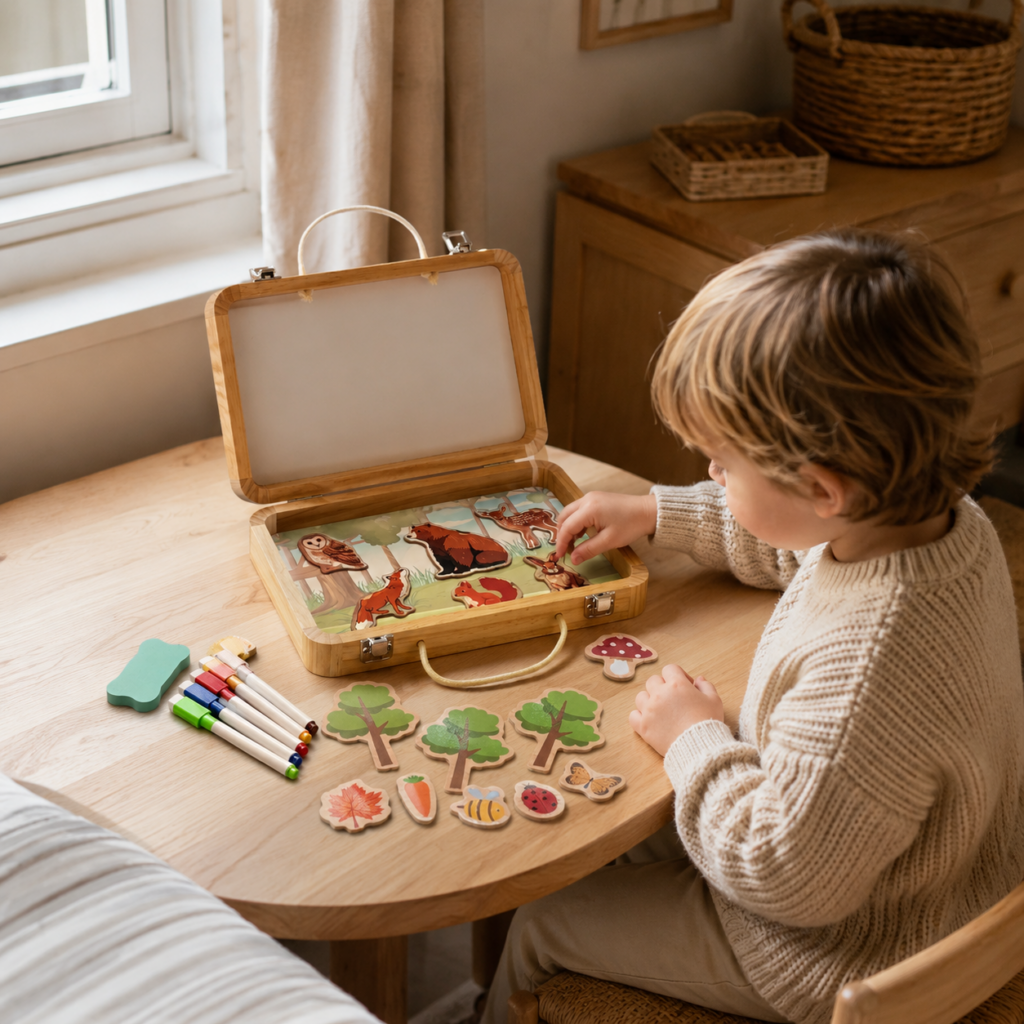
Not all puzzles for a toddler are created equal, and the difference isn’t really about piece count or picture complexity. A puzzle that’s genuinely well suited to a toddler does something specific — it makes a young child concentrate, problem-solve, and finish something on their own — and a few features separate the puzzles that manage this from the ones that end up abandoned half-done.
Fewer, larger pieces beat many small ones. It’s tempting to think more pieces means more challenge, but for a toddler, a puzzle with too many small pieces is simply frustrating rather than engaging. A handful of larger, chunky pieces that a small hand can grip, turn, and place confidently gives a toddler the right level of difficulty — hard enough to require thought, easy enough to actually finish.
The satisfaction of “clicking into place” matters. Puzzles that give a clear, immediate signal when a piece is correctly placed — whether that’s a snug fit, a magnetic pull, or a piece that sits flush — keep a toddler motivated through to the end. A puzzle where it’s unclear whether a piece is right or wrong tends to lose their interest halfway through.
A good puzzle builds concentration, not just recognition. Matching a shape to a hole is a start, but the puzzles that do more for development ask a child to think through the whole picture — where does this piece go relative to the others, what’s missing, what comes next. That’s a meaningfully bigger cognitive step than simple shape-matching, and it’s where real problem-solving skill starts to build.
Reusability matters more than a single correct solution. A jigsaw with one fixed picture gets solved once and then holds limited appeal. A puzzle that can be taken apart and rebuilt differently each time — or combined with other activities — keeps offering a genuine challenge rather than becoming a memorised routine.
Look for a puzzle that does more than fit together. The most engaging puzzles for toddlers tend to layer something extra on top of the core fitting activity — a story, a scene, a bit of imaginative play once the puzzle’s complete — so the challenge of solving it is followed by a reward beyond just “it’s done.”
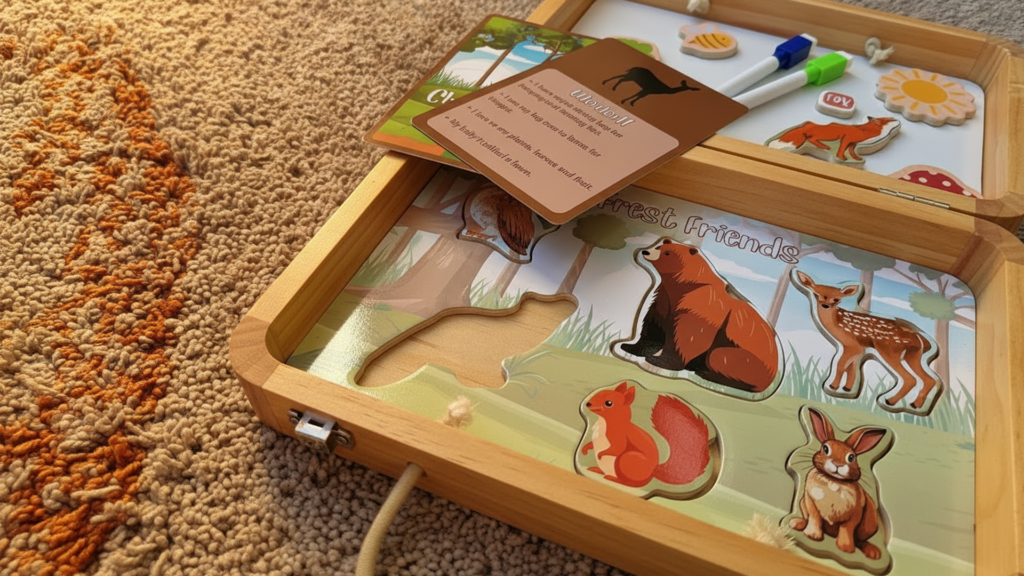
Our own Forest Friends activity box includes a six-piece magnetic woodland puzzle designed with exactly these features. The pieces are large, single-piece wooden animals sized for small hands, each one holding firmly in place on the whiteboard once positioned correctly, so a toddler gets clear, satisfying feedback as they work through it. And because the same pieces can be lifted off and rearranged into a different scene, or used alongside the quiz cards for a bit of imaginative storytelling, the puzzle doesn’t end the moment it’s solved once.
If you’re choosing puzzles for toddlers, look past piece count and picture detail to the things that actually determine whether it gets finished: pieces sized for small hands, clear feedback when something’s right, and enough flexibility that solving it once isn’t the end of the challenge.
Frequently asked questions
How many puzzle pieces are appropriate for a toddler?
For toddlers around age 2 to 3, puzzles with 4 to 12 large, chunky pieces tend to be most appropriate. From around age 3 to 4, many children can manage puzzles with slightly more pieces, though size and grip-ability of each piece still matter more than the total count.
What skills do puzzles help toddlers develop?
Puzzles support fine motor control, hand-eye coordination, spatial awareness, and early problem-solving. Working out where a piece belongs and physically placing it also builds concentration and patience, which are valuable skills well beyond the puzzle itself.
Should a toddler’s first puzzle have a picture or be shape-based?
Both have value. Shape-based puzzles are often a gentler starting point, focusing purely on fit and coordination. Picture-based puzzles add a layer of visual problem-solving, working out where a piece belongs based on the image, which tends to suit slightly older toddlers.
Why does my toddler lose interest in a puzzle quickly?
This is often a sign the puzzle is either too difficult (too many small, similar pieces) or too easy and has already been mastered. A puzzle that offers ongoing variation, such as pieces that can be rearranged into different scenes, tends to hold interest for longer than a fixed, single-outcome puzzle.
Here’s What Else We Make…
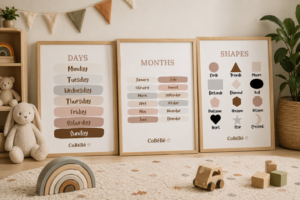
Free Printables for Calm Play at Home
If toy rotation got you thinking about creating a more intentional play space, our free printable library is a good next step. Posters, activity sheets and learning resources designed for the kind of calm, focused play we’ve been talking about — all free to download instantly.