
The words “Montessori-inspired toys” get used loosely. They’re stamped on plastic sorting toys, stacking cups, anything vaguely wooden — often with little connection to what Maria Montessori actually observed about how children learn. If you’re trying to choose montessori-inspired toys with real principles behind them, it helps to know what to actually look for.
Child-led, not toy-led. A Montessori-inspired toy doesn’t perform for the child — it waits for them to decide what to do with it. There’s no button that triggers a light or sound, no single “correct” way to play. The child chooses: sort the pieces, build a scene, draw, ask a question. That choice is where the learning happens, not in a pre-programmed response.
Real materials. Montessori environments favour natural materials — wood, fabric, metal — over plastic, partly for sensory reasons (weight, texture, temperature all give a child information) and partly because natural materials tend to be made with more care, which usually means they last.
Open-ended, not single-purpose. A toy that does one thing gets mastered quickly and shelved. Montessori-inspired play tends to offer several ways in — a toy that can be a puzzle today, a drawing surface tomorrow, and an imaginative scene the day after keeps offering something new, so the child returns to it rather than moving on for good.
Independence over instruction. The goal isn’t a toy that teaches a fact. It’s a toy that lets a child concentrate, work through a small problem, and feel capable of doing it themselves — the quiet confidence that comes from figuring something out unaided, rather than being shown.
Calm over stimulation. Montessori spaces are deliberately uncluttered and quiet. A toy that fits this approach doesn’t shout for attention with noise or flashing lights — it invites a slower, more focused kind of play.
What separates genuine montessori-inspired toys from the rest
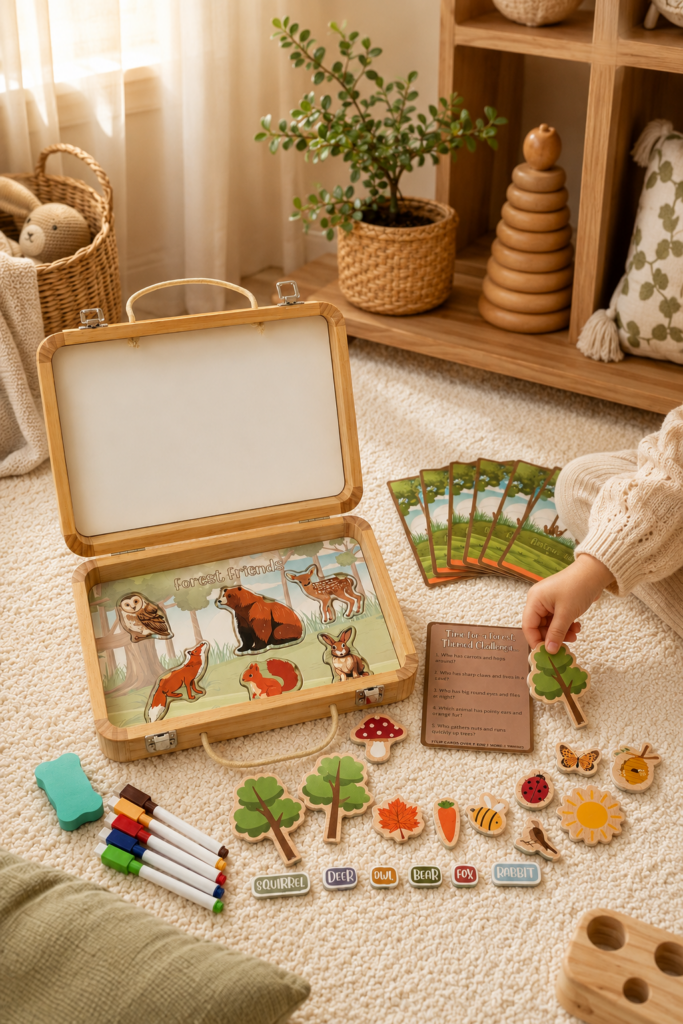
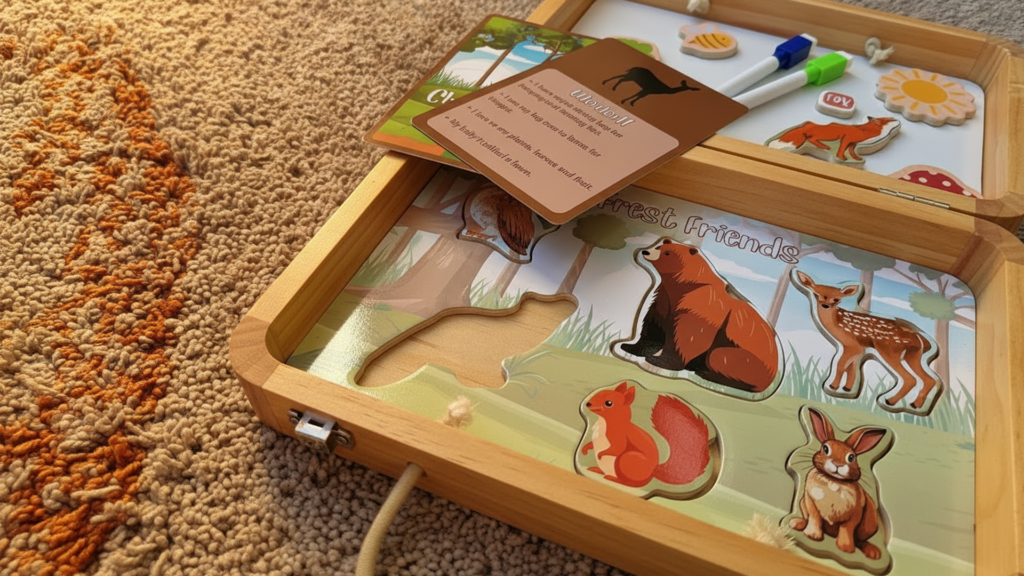
Our own Forest Friends activity box was designed with these principles in mind, which is part of why we describe it as Montessori-inspired rather than claiming it as an official Montessori material (there’s no such thing as official certification for most toys, whatever the packaging says). It’s wooden, child-led, and open-ended — a magnetic woodland scene to build, a whiteboard to draw on, quiz cards to work through — so a three-year-old and a six-year-old can use the same box differently, and neither is being shown the “right” way to play.
If you’re building a play space around these principles, the toy matters less than the approach — fewer things out, more time to explore each one, and space for a child to be genuinely absorbed rather than entertained. A well-chosen Montessori-inspired toy just gives that approach something good to work with.
Frequently asked questions
Is “Montessori-inspired” the same as an official Montessori toy?
Not quite. There’s no formal certification body that licenses toys as “Montessori” — the term comes from Maria Montessori’s educational philosophy, and manufacturers use “Montessori-inspired” to describe toys designed around her principles: child-led, open-ended, made from natural materials. It’s a description of an approach, not an official stamp.
What age is Montessori-style play suitable from?
Montessori principles apply from infancy through the primary years, but the toys themselves vary by stage. For toddlers and preschoolers (roughly ages 2–6), the focus tends to be on practical life skills, sensory exploration, and open-ended materials that support independent problem-solving — which is the age range most wooden activity boxes and puzzles are designed for.
Can a toy be Montessori-inspired if it isn’t wooden?
Yes. Wood is favoured for its sensory qualities and durability, but the defining features are child-led play, open-endedness, and independence — not the material itself. A toy made from fabric, metal, or another natural material can follow the same principles just as well.
How do I know if a toy is genuinely open-ended?
Ask whether there’s more than one way to play with it, and whether a child could still find something new to do with it after a month. If a toy has a single correct outcome — press this, hear that — it’s closed-ended, however educational it looks. A truly open-ended toy invites different play at different ages.
Here’s What Else We Make…
Free Printables for Calm Play
Scavenger hunts, posters, activity sheets and learning resources designed for the kind of calm, focused play we’ve been talking about — all free to download instantly.