Welcome to this weeks blog about Montessori education. Let me share a moment that really stayed with me. One morning, while getting ready for the day, I noticed my son pulling every pot and pan out of the kitchen cupboard. My first instinct was to step in and redirect — the mess, the noise, the rush of the morning all felt overwhelming. But instead, I paused. I realised he wasn’t being “naughty.” He was curious. He wanted to see, touch, and take part in what was happening around him.
That was when it clicked for me: maybe the problem wasn’t his behaviour, but the environment we’d set up. Our home was arranged for adults, not for a little person eager to explore. That thought was the start of my journey into understanding just how much the environment shapes a child’s learning — something Montessori philosophy has been teaching for over a century.
Montessori’s Vision of the Environment
Maria Montessori believed that children don’t just learn in a space — they learn from the space. The environment itself becomes a kind of teacher.
When I think back to that kitchen moment, I see her wisdom in action. My son wasn’t trying to make life harder; he was simply drawn to what was accessible to him. Montessori called this a prepared environment — a space intentionally designed to respect a child’s curiosity and independence.
She described it as “rich in motives which lend interest to activity and invite the child to conduct his own experiences” (Montessori, 1912). That’s exactly what I saw in my son’s eyes that morning: not defiance, but an invitation to let him try.
(Montessori Northwest)
Key Components of a Montessori Environment
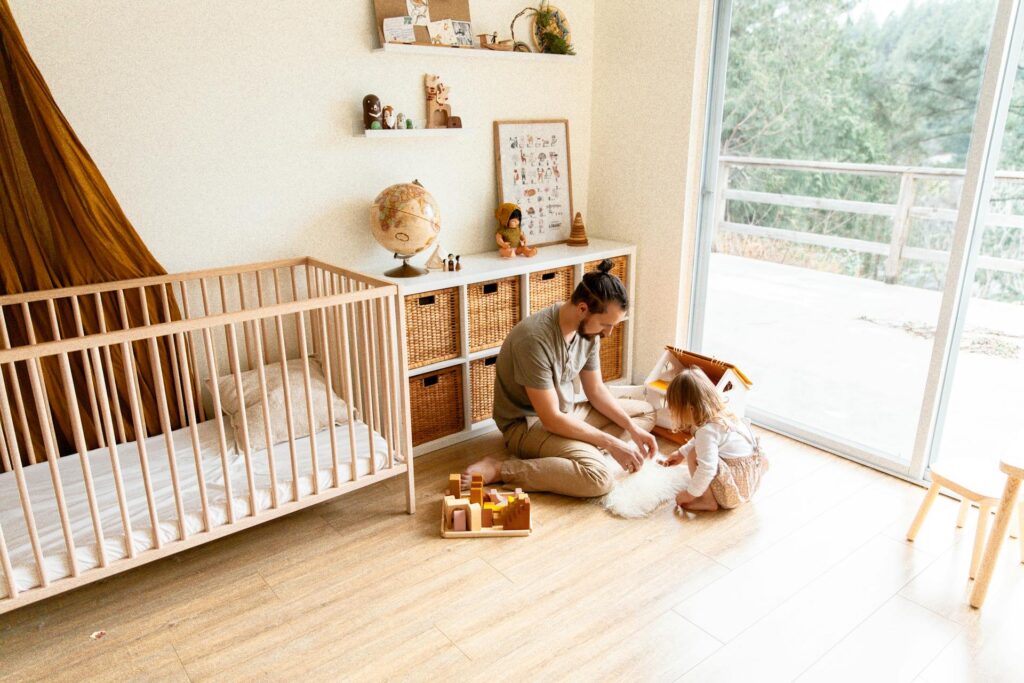
Montessori spaces are designed with calm, clarity, and independence in mind. When I began making changes at home, I noticed how small adjustments had a big effect:
- Order and Structure – Giving each pot, toy, or book a consistent place helped my son know what to expect. The morning chaos started to soften.
- Accessibility – Just as he pulled pans from the cupboard, I realised he needed shelves and tools at his own level so he could choose independently.
- Child-Sized Furniture – A small table and chair gave him ownership of mealtimes.
- Natural Materials – When I swapped plastic cups for a small glass one, he held it more carefully — and with pride.
- Beauty and Simplicity – We reduced clutter, and suddenly our home felt calmer for all of us.
- Freedom of Movement – Letting him move freely in safe spaces encouraged more focused play.
- Purposeful Materials – Instead of dozens of toys, a few carefully chosen items invited deeper concentration.
These changes weren’t about making our home look like a Montessori classroom — they were about meeting his developmental needs through our environment.
(Montessori Academy)
What Science Tells Us
Modern research backs up what Montessori knew instinctively.
A 2014 study found that cluttered, overly decorated classrooms reduced focus and increased off-task behaviour in preschoolers (Fisher et al., 2014). I could see the same truth at home — when my son was surrounded by too many toys, he flitted from one thing to another. But when we simplified, he stayed absorbed for longer.
Montessori environments, with their order and calm, nurture the brain’s executive functions — things like concentration, impulse control, and memory. Research by Lillard & Else-Quest (2006) showed that children in Montessori classrooms performed better socially and academically compared to peers in traditional classrooms.
The science matched what I was living: the calmer our space, the calmer and more focused my child became.
(Trillium Montessori)
Clearing Up Common Misconceptions
As I started telling friends about Montessori, a few questions always came up:
- “It’s just minimalist décor.”
When I first cleared our shelves, it wasn’t about Instagram aesthetics — it was about making it easier for my child to choose and focus. The calm look is a byproduct of a functional design. - “The environment replaces the teacher.”
At home, I quickly learned the balance: the environment supported independence, but I still had to guide gently and step in when needed. - “It’s rigid.”
Freedom within limits was the key. My son had choices, but within a safe and thoughtful structure. - “You need expensive materials.”
We didn’t buy a single “official” Montessori toy at first. A small stool by the sink, a real cup, and a child-sized broom made the biggest difference.
Bringing Montessori Environment Into Your Home
Bit by bit, we reshaped our home — not perfectly, but intentionally. You can do the same with simple steps:
- Place a few toys on low shelves, and rotate them to keep things fresh.
- Add a stool so your child can reach the sink and help with washing hands or dishes.
- Give them a small broom or cloth so they can take part in daily life.
- Keep spaces calm and uncluttered, inviting them to join in tidying up.
- Offer real, natural materials where possible — a small wooden bowl, a real spoon.
Most importantly, observe. I learned more by quietly watching my son in a simplified environment than from any parenting book. He showed me that independence isn’t about doing things perfectly — it’s about being trusted to try.
(Montessori Academy – Prepared Environment)
A Gentle Conclusion
That morning in the kitchen, I thought I was watching mischief. What I was really seeing was the raw curiosity that Montessori believed every child holds inside them.
By shaping the environment — whether a classroom or a corner of our home — we send a message: I see you. I trust you. I believe you are capable.
Montessori reminds us that the environment is not just background — it’s an active part of learning, growth, and independence. For me, it transformed daily chaos into moments of connection and calm. And that is why the environment matters.
Montessori FAQs
Q: Do I need to redesign my whole house for Montessori?
A: Not at all. Start with one room or even one shelf. Small changes have big impact.
Q: Can Montessori environments work in small spaces?
A: Yes. Even a single low shelf with a few items can create a child-friendly environment.
Q: What if my child makes a mess?
A: Mess is part of learning. The goal isn’t a spotless home but a space where children can participate and learn responsibility.
Q: Isn’t this just about having fewer toys?
A: Simplifying helps, but Montessori is about intention — offering purposeful choices and respecting your child’s independence.
Further Reading & Sources
- Prepared Environment – Montessori Academy
- Montessori Education – Wikipedia
- About Montessori Education – Montessori Northwest
- Montessori Method of Education – Simply Psychology
- Montessori vs Traditional Education – Trillium Montessori