
How Screen Time May Be Quietly Changing the Way Children Play and Think
A Familiar Scene
It was a rainy Saturday afternoon — the kind that used to mean blanket forts and board games. We normally take the kids round their nan’s house around 4pm for a family meal where they blow off steam with their cousins and get endless hugs from their grandparents. However this week that wasn’t an option as they were out of town.
In my living room, the only glow came from a tablet screen. My five-year-old sat quietly, halfway through his third episode of something neither of us could name.
Next to him sat a box of Jurassic World Lego bricks that he had received for his birthday not too long ago — untouched.
It wasn’t the first time I’d noticed it. What used to be stories about “Mosasaurus missions” and “dragon cities” had slowly been replaced by stillness. I’m not anti-screens; both of my kids have tablets, and I rely on them some days just to get through dinner prep. But lately I’ve been wondering if screen time is slowly reshaping the way children play — and imagine.
Have you ever had the same thought? Researchers are asking it too. A report from the Royal College of Paediatrics and Child Health (2020) found that screen use is rising among children under five, with some spending more than three hours a day on devices. At the same time, early-years educators are voicing concern that open-ended play — the kind that fuels imagination — is quietly being pushed aside.
So what’s really happening here? How does screen time affect creativity, and what can we do about it without ditching technology altogether?
The Imagination Gap
Imaginative thinking isn’t just “pretend play.” It’s how children learn to problem-solve, empathise, and explore ideas that don’t yet exist. The Royal Institution (2019) describes it as “cognitive flexibility” — the brain’s ability to switch perspectives and generate new ideas.
According to BookTrust, imagination grows through stories, conversation, and free play. It’s how children test out the world in miniature — building confidence, empathy, and resilience along the way.
Even boredom plays a role. BBC Tiny Happy People (2021) explains that when children are left to their own devices — the non-digital kind — they often turn inward, inventing their own games and storylines. That daydreaming time activates what neuroscientists call the default mode network, the part of the brain linked to creative thinking and problem-solving. When screens fill every pause, that inner space can get crowded out.
The Rise of Screen Time
Let’s be honest: screens are everywhere, and a lot of us depend on them.
According to Ofcom (2023), nearly 90% of UK children aged 3–4 watch online videos, and more than half use tablets daily. The pandemic only accelerated this, with digital tools becoming essential for work, school, and sanity.
This isn’t about guilt. I’ve handed my kids a tablet in a supermarket queue more times than I can count. The real issue is what gets replaced — the quiet moments that used to invite imagination.
When screens fill every gap, there’s simply less room for creative play.
What the Science Says
Neuroscientists studying creativity talk a lot about that default mode network — the area of the brain that lights up during daydreaming and imaginative play.
When children spend long stretches on fast-paced digital content, that network becomes less active (Harvard Medical School, 2021). Over time, this can affect how easily they entertain themselves or come up with ideas independently.
A longitudinal study from the National Institutes of Health (2021) found that children with higher daily screen use showed lower scores in language and executive function — two abilities strongly linked to creativity and self-control.
It’s not that all screen time is bad. The key difference is passive versus active use. Watching endless clips on YouTube doesn’t stimulate creativity in the same way that co-viewing an educational video and discussing it together does. Apps that encourage storytelling, building, or coding (like Scratch Jr or Toca Boca) can still support imagination — especially when used alongside an adult.
As one expert from New York-Presbyterian Health Matters (2022) puts it, “It’s less about the screen and more about what the screen is replacing.”
What We’re Losing — and What We Can Reclaim
When screens take over, hands-on play often fades into the background.
But those physical, messy, imaginative moments are what build the creative foundation for life.
As The Imagination Tree (2020) explains, play that involves building, storytelling, or pretend scenarios strengthens a child’s narrative thinking — their ability to create and follow storylines.
Similarly, Nurture Store encourages “play provocations”: small setups like pinecones and magnifying glasses that invite curiosity and exploration.
Child psychologist Dr. Teresa Belton (BBC, 2019) reminds us that boredom isn’t the enemy; it’s “crucial for developing the internal stimulus to be creative.” That space — the bit between “I’m bored” and “I’ve got an idea” — is where imagination lives.
In our house, we’ve started bringing some of that back: science experiments in the kitchen, blanket forts, even using cardboard boxes as “boats.” It’s not glamorous, and it doesn’t always last long, but it feels alive again.
Montessori Insight — Observation Over Overload
Maria Montessori never had to compete with tablets, but her philosophy fits perfectly in this conversation.
Montessori environments are designed for focus — calm, ordered, and intentional. The Montessori Notebook (2022) explains that overstimulation (too many bright sounds or visuals) can disrupt a child’s ability to concentrate. The Montessori solution? Fewer materials, more meaningful engagement.
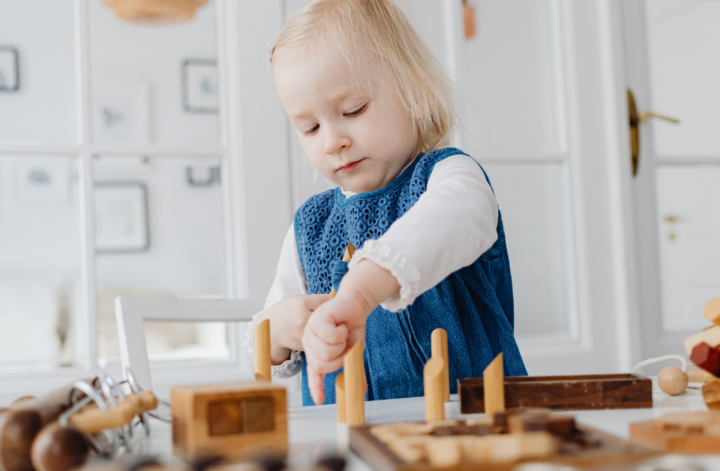
The Montessori Society UK adds that true imagination doesn’t come from constant entertainment but from self-directed play — where the child leads and the adult observes. Pouring water, sweeping, building with blocks — it’s slow, purposeful, and creative in its own right.
Practical Shifts for Parents
Here are a few realistic ways to nurture imagination without banning screens altogether:
- Create a Screen-Free Corner A simple area with books, blocks, or play dough can become a calm retreat for free play.
- Swap, Don’t Scrap Replace one video session a week with an activity like story stones or a cardboard-box challenge.
- Co-View and Extend Watch something together, then act it out, draw it, or invent a new ending.
- Invite Real-World Projects Cooking, gardening, or DIY builds focus and creativity while connecting everyday skills.
- Give Warning and Choice Use a timer to end screen sessions smoothly and suggest what’s next: “After this, let’s build a fort.”
- Follow Their Interests Offline If your child loves dinosaurs, make a mini excavation bin or nature scavenger hunt.
- Let Boredom Happen Resist jumping in with entertainment — give their imagination time to wake up.
Expert Voices & Real Parents
BBC Tiny Happy People (2021) recommends simple back-and-forth “serve and return” chats with children — it’s one of the easiest ways to build imagination and language.
The Dad Lab continues to share hands-on experiments that spark curiosity, showing that science and play can go hand in hand.
And Five Minute Mum reminds parents that creativity doesn’t require perfect setups — “a few cups and a ball can become a castle defence game.”
One parent I spoke to said they started “Adventure Fridays” — no screens, just a new walk, a new game, or a picnic in the living room. “It’s become the highlight of our week,” she told me. Simple, but powerful.
A Gentle Conclusion
The truth is, our children’s imagination isn’t lost — it’s just waiting for space.
Screens aren’t the enemy; they’re a tool. It’s what we do in between that matters.
By mixing mindful screen time with simple, hands-on play, we help our children rediscover that spark — the one that turns a cardboard box into a rocket ship or a puddle into an ocean.
It doesn’t need to be perfect or planned — just possible.
References
- Royal College of Paediatrics and Child Health (RCPCH) — Screen time and family: building healthy habits — Link
- RCPCH — The health impacts of screen time: a fact sheet for parents — Link
- Childnet International — Screen Time Guidance for Parents and Carers — Link
- Ofcom — Children and Parents: Media Use and Attitudes Report 2023 — Link
- World Health Organization (WHO) — UN recommends no screen time for babies, only 1 hour for kids under 5 — Link
- The Imagination Tree — It’s Playtime! Imaginative Play — https://theimaginationtree.com/its-playtime-5-imaginative-play/
- The Imagination Tree — The Central Importance of Play — https://theimaginationtree.com/central-importance-of-play/