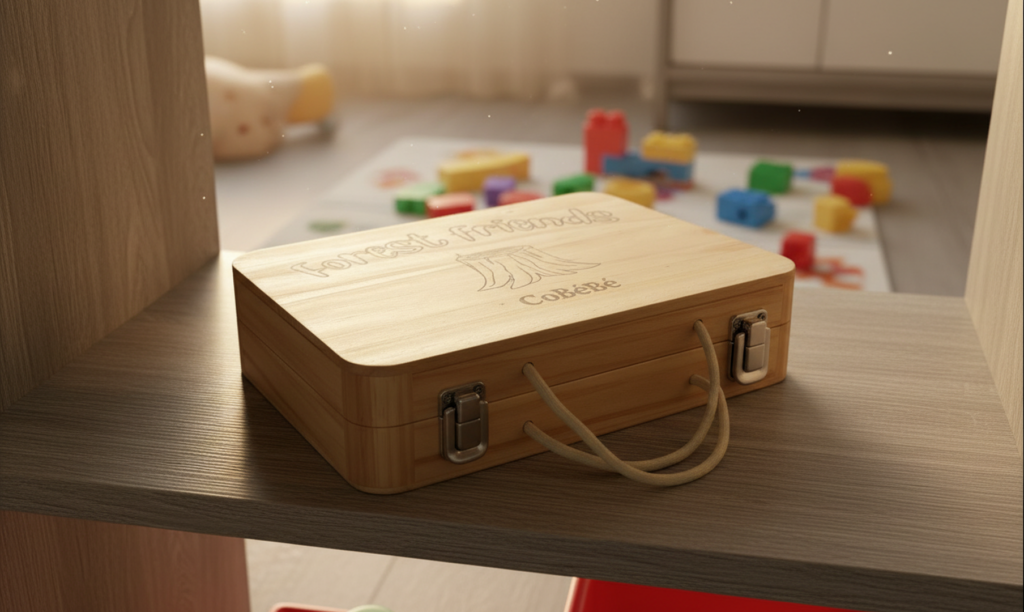
The wooden activity box sitting on our kitchen shelf has been opened, closed, carried to the sofa, packed into a bag and brought back out again more times than I can count.
That’s the thing nobody tells you when you’re standing in a toy shop trying to decide what to actually buy for a toddler. You’re not just buying a toy. You’re buying something that has to earn its place in a home that already has too much stuff, survive real family life, and genuinely hold a child’s attention beyond the first ten minutes.
Finding the right wooden activity box for toddlers is harder than it sounds. Here’s what we’ve learned — and what we think actually matters.
What Is a Wooden Activity Box for Toddlers?
A wooden activity box is exactly what it sounds like — a box, made from wood, that opens up into one or more play experiences. Unlike activity cubes (which are fixed, freestanding structures with different panels on each side), a wooden activity box is portable, self-contained and usually designed to travel.
The best ones pack multiple types of play into a single compact set. Puzzles, drawing surfaces, magnetic play, creative props, learning cards — all stored neatly inside something a toddler can open themselves, carry themselves and feel genuine ownership over.
That portability is what separates a wooden activity box from most other wooden educational toys for toddlers. It’s not just for the playroom floor. It’s for the car, the restaurant table, the waiting room, the hotel room, the grandparents’ house. It goes where your family goes and solves the problem of keeping a child happily occupied somewhere difficult.
Why Wooden Matters More Than You’d Think
Walk into any toy shop and you’ll find no shortage of activity sets for toddlers. Most of them are plastic, battery-powered and designed to grab attention through noise and flashing lights.
Those features do grab attention — for about three minutes. After that, there’s nothing left to discover.
Wooden toys work differently. They’re quieter, slower and more open-ended. A child using a wooden activity box has to bring their own imagination to it. They decide what the magnetic animals do, where the pieces go, what story gets drawn on the whiteboard. That kind of play — where the child leads and the toy follows — is exactly what builds sustained concentration, creativity and fine motor skills naturally over time.
Research published in PMC (the National Institutes of Health’s open access journal archive) found that children talked significantly less and produced fewer unique words when playing with electronic toys compared to traditional toys, with wooden and open-ended play consistently associated with richer parent-child interaction and more creative language development. (Source: PMC / National Institutes of Health, 2022 — https://pmc.ncbi.nlm.nih.gov/articles/PMC9286016/)
None of that means wooden toys are automatically good. Quality varies enormously — and in the wooden activity box category specifically, the gap between a well-made product and a disappointing one is significant. But when you find the right one, the difference in how a child plays with it, and how long they play with it, is genuinely noticeable.
What to Look For in a Wooden Activity Box for Toddlers
Not all wooden activity boxes are created equal. Here’s what genuinely matters when you’re choosing one for a child aged 3 to 5.
Build quality above everything else
The most common complaint parents have about cheaper wooden activity sets is that they fall apart quickly. Whiteboards come loose from their frames. Wood splits or gives splinters. Pieces go missing within days. A good wooden activity box should feel solid in small hands — not lightweight or flimsy. Check that any whiteboard or drawing surface is permanently fixed rather than removable, and that the locking mechanism feels secure enough to survive a bag being thrown onto a back seat.
Piece size and safety
For children aged 3 and above, piece size matters enormously. Tiny components — small animal limbs, miniature accessories, fiddly connectors — get lost, cause frustration and in the worst cases become safety hazards. The best wooden activity boxes use generously sized pieces that little hands can actually grip, move and place without adult help. Always check the age rating and look for EN71 safety certification before buying. If a listing doesn’t mention it, ask.
More than one type of play
A wooden activity box earns its price when it offers genuinely different play experiences rather than variations on the same activity. The combination that works best for toddlers aged 3 to 5 tends to be something tactile (a puzzle or magnetic pieces to manipulate), something creative (a drawing surface), and something imaginative (open-ended props or cards that spark storytelling and learning). That variety is what makes a child return to the same box again and again rather than setting it aside after a single session.
Portability that actually works
Travel-friendly claims are everywhere on product listings. What they actually mean varies wildly. A truly portable wooden activity box for toddlers should have a secure closing mechanism so nothing spills in transit, a handle a child can carry themselves, and a compact footprint that fits on a plane tray table or restaurant table without taking over the whole surface. If it needs to be packed into a separate bag just to travel safely, it’s not really a travel toy.
Something to grow into
The best screen-free toys for toddlers don’t have a fixed end point. They offer layers — a child aged 3 uses them one way, a child aged 5 uses them differently. Open-ended magnetic play and drawing activities naturally scale with a child’s development in a way that shape sorters and bead mazes don’t.
The Wooden Activity Box We Made
We’re CoBéBé — a small independent brand built around the belief that children learn best through simple, screen-free, hands-on play. We started making Forest Friends because we kept buying wooden activity sets that looked beautiful in product photos and let us down in real life.
Whiteboards that fell loose from their frames. Magnetic pieces with weak hold. Tiny animal parts that vanished under the sofa on day two. Sets that our children explored once and set aside.
So we designed a wooden activity box for toddlers from scratch, fixing every single one of those problems.
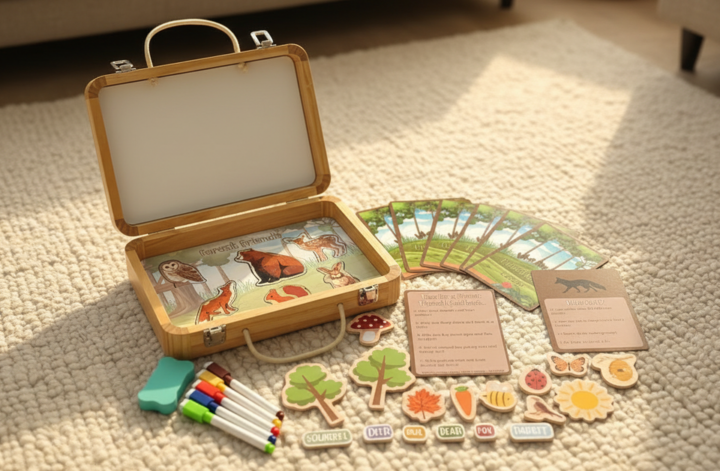
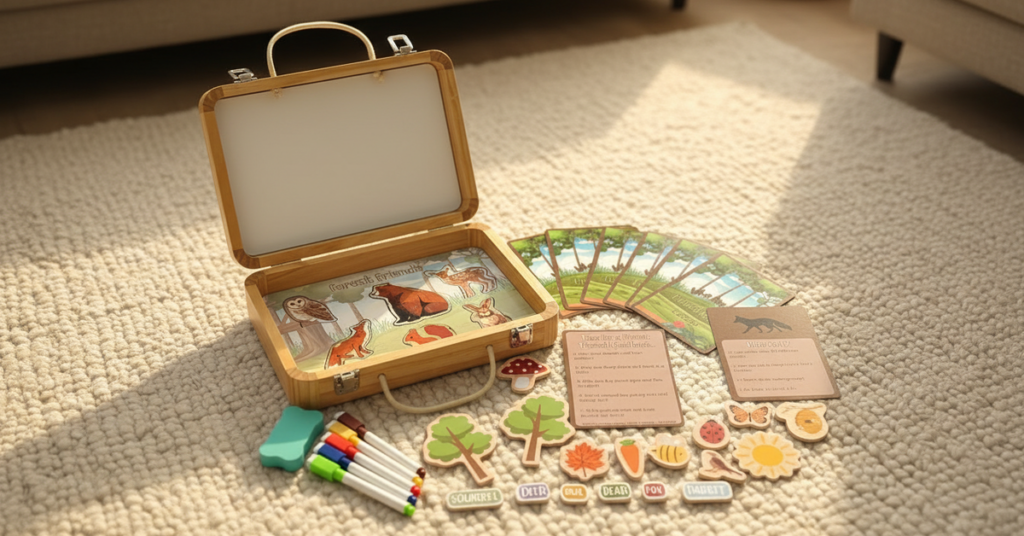
Forest Friends opens into two play surfaces — a fixed six-piece magnetic puzzle in the base featuring woodland animals (rabbit, squirrel, bear, deer, fox and owl), and a permanently fixed whiteboard in the lid for drawing, storytelling and open-ended creative play. The whiteboard is built into the lid and will never fall over, come loose or expose sharp edges.
The cotton drawstring bag inside holds sixteen additional woodland magnetic props — trees, mushrooms, nature pieces — for building scenes on the whiteboard. Five quality dry-erase pens and an eraser are included, along with seven animal quiz cards that introduce each woodland creature with fun facts children actually want to remember.
Every piece is designed for little hands aged 3 and above. The puzzle animals are single solid magnetic-backed shapes — no tiny limbs, no fragile connectors, nothing to lose behind the sofa. The box closes with a secure locking clasp and has two rope handles so toddlers can carry it themselves.
Forest Friends is EN71 safety tested and CE marked.
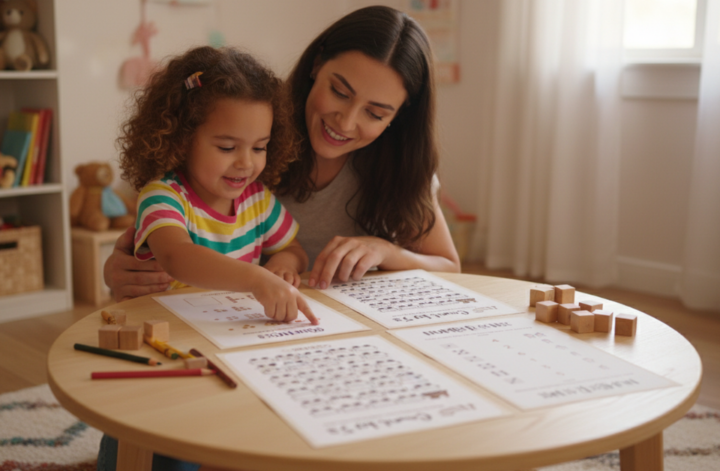
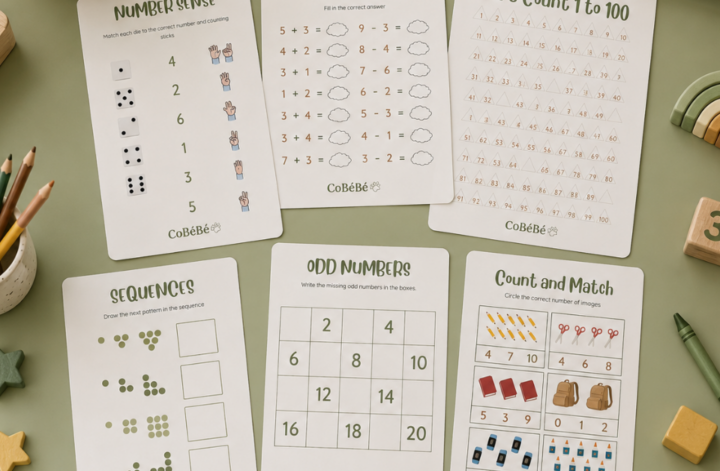
And inside the box you’ll find a product insert with a scannable QR code that unlocks a free collection of downloadable extras — a Forest Explorers certificate your child can earn, play prompts, activity worksheets and calm parenting prompts designed to support meaningful, screen-free play at home long after the box is first opened.
You can find Forest Friends in our shop here:
How a Wooden Activity Box Compares to Traditional Activity Cubes
Activity cubes are the most common result when parents search for wooden activity boxes for toddlers. They’re freestanding, fixed structures with different activities on each panel — bead mazes, shape sorters, spinning wheels, mirrors.
They’re genuinely good toys for younger toddlers, particularly children aged 1 to 2 who are still developing early motor skills and enjoy simple cause-and-effect play.
But they have real limitations for children aged 3 and above.
They don’t travel. An activity cube lives on the floor and stays there. It’s not going to the airport or the restaurant or the car journey that still has two hours to go.
They’re fixed. Once a child has explored every panel, there’s nothing new to discover. The play doesn’t evolve as the child does.
They don’t encourage storytelling or open-ended imagination in the same way. The activities are self-contained — spin this, sort that — rather than truly open-ended.
A wooden activity box for toddlers aged 3 to 5 fills a genuinely different need. It grows with the child, travels with the family, and invites a slower, more imaginative, more child-led kind of play that develops naturally over months rather than days.
Neither is better in every situation. But if your child is 3 or older and you want something that works beautifully at home AND solves the problem of keeping them happily occupied away from home, a wooden activity box is almost always the better fit.
Getting the Most From a Wooden Activity Box
A few things that make a real difference in how much a toddler gets from a wooden activity box for toddlers:
Introduce it slowly. Rather than tipping everything out at once, start with just the puzzle. Let your child explore that for a session before introducing the whiteboard, then the magnetic props, then the quiz cards. Drip-feeding the elements extends the novelty and gives each activity its own moment to land properly.
Let them lead. Resist the urge to show them the correct way to use it. A child who puts the magnetic fox on the whiteboard and draws a story around it is doing exactly what the toy is designed for, even if it looks nothing like the product photo. That imaginative play is the point.
Pack it properly for travel. Close the box and engage the clasp before putting it in a bag. The locking mechanism keeps everything contained and means nothing gets lost between home and wherever you’re headed. It’s genuinely carry-on friendly.
Use the quiz cards at unexpected moments. The animal facts work brilliantly as a quiet activity at a restaurant table or as a gentle wind-down before bed — not just during structured play time at home. They’re conversation starters as much as learning tools.
What Makes a Wooden Activity Box Worth the Money
A well-made wooden activity box for toddlers costs more than a plastic alternative. That’s just true. And it’s a fair thing to think carefully about before buying.
But here’s what parents who felt the investment was justified almost always say: it replaced several cheaper toys that didn’t last, and the overall cost worked out lower. One wooden activity box that’s genuinely played with for two years is better value than three cheaper toys that lasted a month each.
The three things that come up most often when parents talk about wooden activity boxes that genuinely worked for their family are: that the child kept coming back to it weeks and months later, that it solved the problem of keeping a toddler occupied somewhere away from home, and that it felt like a toy worth owning rather than something to feel guilty about adding to an already full toy box.
Those three things — longevity, real portability and genuine play value — are exactly what we designed Forest Friends around. It’s a wooden activity box for toddlers that we’d recommend without hesitation, and one we genuinely use ourselves.
If you’d like to take a look, you can find it in our shop here:
Frequently Asked Questions
What age is a wooden activity box suitable for?
Most wooden activity boxes for toddlers are designed for children aged 3 and above. This is because they typically include magnetic pieces and drawing accessories that require adult supervision for younger children. Forest Friends by CoBéBé is EN71 safety tested and recommended for ages 3 and above.
What is the difference between a wooden activity box and an activity cube?
An activity cube is a fixed freestanding toy with different activities on each panel, designed mainly for children aged 1 to 2. A wooden activity box for toddlers is portable and self-contained, making it suitable for travel as well as home play. Activity boxes typically offer more open-ended, imaginative play experiences for children aged 3 and above, and can be carried and used anywhere.
Are wooden activity boxes good for travel?
Yes — a well-made wooden activity box is one of the best travel toys for toddlers because it packs multiple activities into one compact, lockable case. Look for one with a secure clasp and a handle your child can carry themselves. Forest Friends by CoBéBé fits on a plane tray table and works brilliantly on car journeys, at restaurants and in hotel rooms.
What should I look for in a wooden activity box for a 3 year old?
For a 3 year old, look for generously sized pieces with no small parts, a permanently fixed whiteboard rather than a removable one, strong magnets that hold reliably, EN71 safety certification and a variety of play types. The best wooden activity boxes for toddlers aged 3 offer something tactile, something creative and something that encourages imaginative storytelling and learning.
How do wooden toys help toddler development?
Wooden toys support toddler development by encouraging open-ended, imaginative play that builds fine motor skills, concentration, creativity and language. Unlike electronic toys, they require the child to lead the play rather than react to lights and sounds — research from the National Institutes of Health suggests this leads to richer learning experiences and greater language development in young children.
Is a wooden activity box a good gift for a toddler?
A wooden activity box makes an excellent gift for toddlers aged 3 to 5 for birthdays or Christmas. Because it combines multiple activities in one beautiful wooden case, it feels like a complete, considered gift rather than a single toy. Look for one that is EN71 safety tested, travel-friendly and offers play that grows with the child over time rather than something they will set aside after a few days.