What you’ll learn in this article
- What number sense for preschoolers actually means, without making it sound more complicated than it is.
- Why early maths is about more than counting to 10.
- Simple ways to build early maths skills through play, routines and printable activities at home.
When parents think about early maths, counting is usually the first thing that comes to mind.
And I get why.
It is one of the easiest things to notice.
Your child counts the stairs. They count their fingers. They count snacks on a plate. They might proudly count to 20, then 50, then 100 if they have really got into it.
But counting out loud is only one small part of early maths.
A child can learn the rhythm of number words without fully understanding what those numbers mean. They might say “one, two, three, four, five” perfectly, but still find it tricky to count five actual objects without skipping one, counting one twice, or forgetting where they started.
That is normal.
It does not mean they are bad at maths. It usually means they are still building number sense.
Number sense for preschoolers is about helping children understand numbers in a real way. Not just saying the words, but slowly understanding amount, order, more, less, patterns, matching, and what happens when we add or take away.
That sounds like a lot, but at home it can be very simple.
It might be your child noticing they have more grapes than their sibling.
It might be lining up toy cars and realising one is missing.
It might be spotting a pattern with blocks.
It might be counting the steps on the way upstairs.
It might be asking for “one more” because they understand that adding one changes the amount.
This is why I like thinking about early maths through play. It takes the pressure off. You do not need to turn your kitchen table into a classroom. You can use the normal little moments that already happen during the day.
What number sense for preschoolers actually means
Number sense is a child’s growing understanding of what numbers mean.
At preschool age, this often includes things like:
- recognising small amounts
- matching number words to real objects
- understanding that numbers come in an order
- noticing more and less
- comparing groups
- spotting simple patterns
- beginning to understand one more and one less
- linking written numbers to actual quantities
So if your child sees three biscuits and understands there are three, that is number sense.
If they can tell that five toy animals is more than two toy animals, that is number sense.
If they understand that adding one more block makes the tower have one extra block, that is number sense too.
It is not about rushing into formal sums.
It is about building the foundations underneath.
NRICH, from the University of Cambridge, has a helpful section on early number sense and early years number activities. Their resources focus on helping children build a strong sense of number through exploration, reasoning and problem-solving, rather than just memorising answers.
That is the bit I think matters for parents.
Early maths does not have to be forced. But children do need chances to use numbers in real situations.
Why counting alone is not enough
Counting is useful, but it can be a bit misleading.
A child might be able to count to 30 because they have memorised the sequence. That is still a good skill, but it does not always mean they understand quantity.
It is a bit like a child singing the alphabet song. They may know the song before they understand each letter properly.
Numbers can be similar.
A child may know the words, but still need time to connect those words to actual amounts.
This is why number sense for preschoolers needs more than reciting numbers.
A few useful early maths questions are:
- Can they count objects one at a time?
- Do they understand that the last number counted tells them how many there are?
- Can they compare two groups?
- Can they see when something has been added or taken away?
- Can they recognise a number and connect it to a real amount?
None of this has to be tested formally. In fact, I would avoid making it feel like a test most of the time.
You can usually see these skills during play.
If your child gives one plate to each teddy during pretend play, they are working with matching and one-to-one correspondence.
If they count toy animals into a box, they are practising quantity.
If they build towers and compare which one is taller, they are using early comparison language.
That all counts.
How children build number sense through play
Children usually understand early maths best when they can touch, move and see what is happening.
That is why real objects are so helpful.
Blocks, crayons, toy animals, pasta shapes, buttons, socks, sticks, snack pieces — anything can become part of a simple counting moment.
You might say:
“Can you put three cars in the basket?”
Or:
“You’ve got four crackers. What happens if I give you one more?”
Or:
“We need two socks. One for this foot and one for that foot.”
These little moments help children connect number words to real things.
That matters because numbers are abstract. The written number 4 does not naturally mean much to a young child until they have seen “four” in lots of real situations.
Four blocks.
Four grapes.
Four fingers.
Four jumps.
Four animals.
The more they experience numbers in normal life, the more those numbers start to make sense.
This is where learning through play works well. It gives children a reason to use numbers without it feeling like a lesson.
Simple number sense activities at home
You do not need complicated activities to build number sense for preschoolers.
A few small ideas are enough.
You can count everyday objects together:
- stairs
- shoes
- spoons
- cars
- toy animals
- blocks
- snacks
- books
You can compare amounts:
“Which plate has more?”
“Who has fewer?”
“Do we have enough cups?”
“Which tower is taller?”
You can use simple instructions:
“Can you find two dinosaurs?”
“Can you put five blocks on the mat?”
“Can you give one teddy to each person?”
You can also add number language to pretend play.
If your child is playing shops, you can count pretend coins.
If they are playing café, you can count plates or cups.
If they are building a train track, you can count the pieces.
If they are playing with animals, you can sort them into groups.
The point is not to interrupt the play constantly. That can get annoying for children quickly. It is more about gently noticing chances to bring numbers in.
A little bit here and there is enough.
Pattern activities help more than we realise
Patterns are a big part of early maths.
They help children notice order, repetition and what might come next.
That might look like:
red, blue, red, blue
big, small, big, small
clap, tap, clap, tap
car, block, car, block
At first, children might copy a pattern. Later, they may start predicting what comes next. Over time, that kind of thinking supports sequencing, logic and problem-solving.
You can make simple patterns with almost anything:
- Lego or blocks
- beads
- stickers
- socks
- leaves
- toy animals
- coloured pencils
- snack pieces
Printable sequence activities can also work well because they give a clear starting point.
I find that useful at home. Sometimes a blank page or open-ended play setup can feel like too much. A simple printable gives a child something clear to do without needing loads of preparation from you.
Matching numbers to amounts
One useful part of number sense for preschoolers is matching numerals to real amounts.
That means understanding that the written number 3 connects to three actual things.
This can take time.
A child might recognise the symbol 3 before they really understand three as a quantity. Or they might understand three objects but not yet recognise the written numeral.
Both are normal.
You can help by linking the two together.
For example:
- Show the number 4, then count four blocks.
- Trace the number 5, then draw five dots.
- Roll a dice, count the spots, then find the matching number.
- Count fingers and match them to a numeral.
- Use number cards with toy animals or counters.
This makes the written number less random.
It gives it meaning.
Number tracing is useful, but it is not the main thing
Number tracing can be helpful, especially for pencil control and number recognition.
But tracing alone does not build full number sense.
A child can trace the number 6 neatly and still not understand what six means.
So I would use tracing as one small part of the bigger picture.
For example, instead of only tracing a number, you could:
- trace the number
- count that amount of objects
- draw that number of dots
- clap that many times
- find that number on a page
That way, the child is not just copying a shape. They are connecting the number to quantity.
This is the same reason I like simple number sense printables that mix different skills together. Counting, tracing, matching, patterns and simple addition all support each other.
Early addition and subtraction can stay simple
Addition and subtraction do not need to start with written sums.
For preschoolers, it can begin with real objects.
“You have two cars. I’m adding one more. Now how many?”
Or:
“There were five raisins. You ate one. How many are left?”
That is early addition and subtraction.
You can use toys, snacks, fingers, counters, blocks, anything.
The main thing is that your child can see the change happening.
Written sums can come later. Some children enjoy them early, and that is fine. But they make more sense when the child already understands what adding and taking away actually looks like.
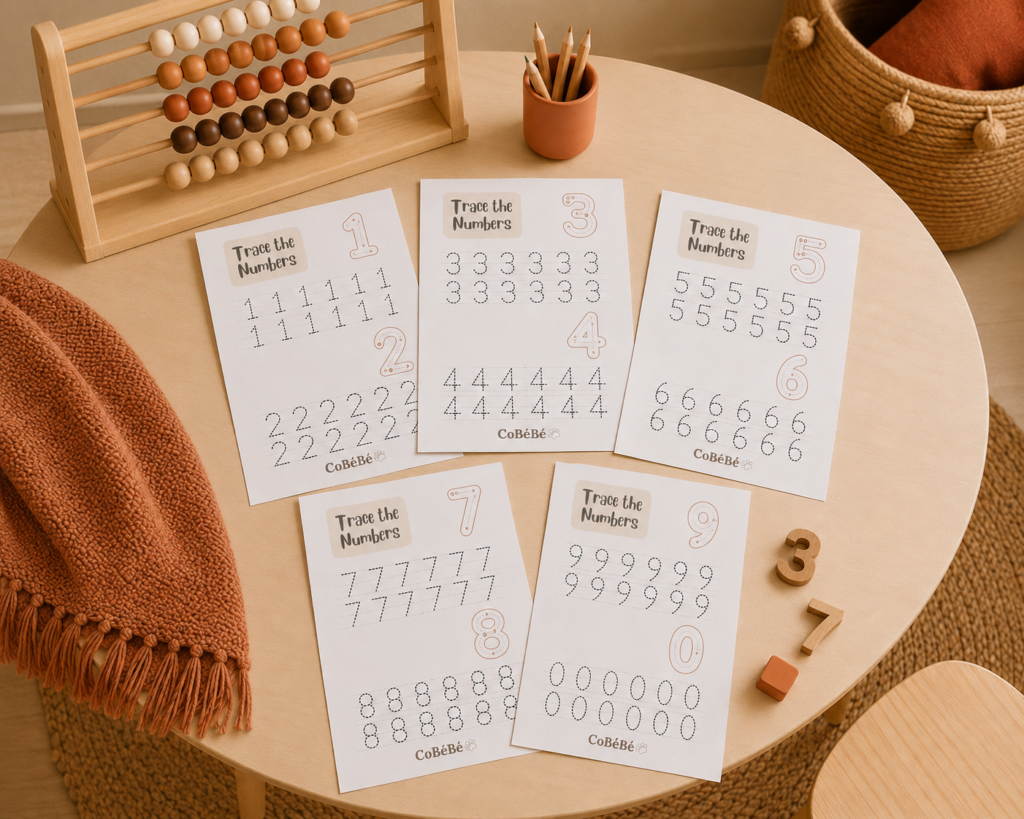
A simple free printable to try
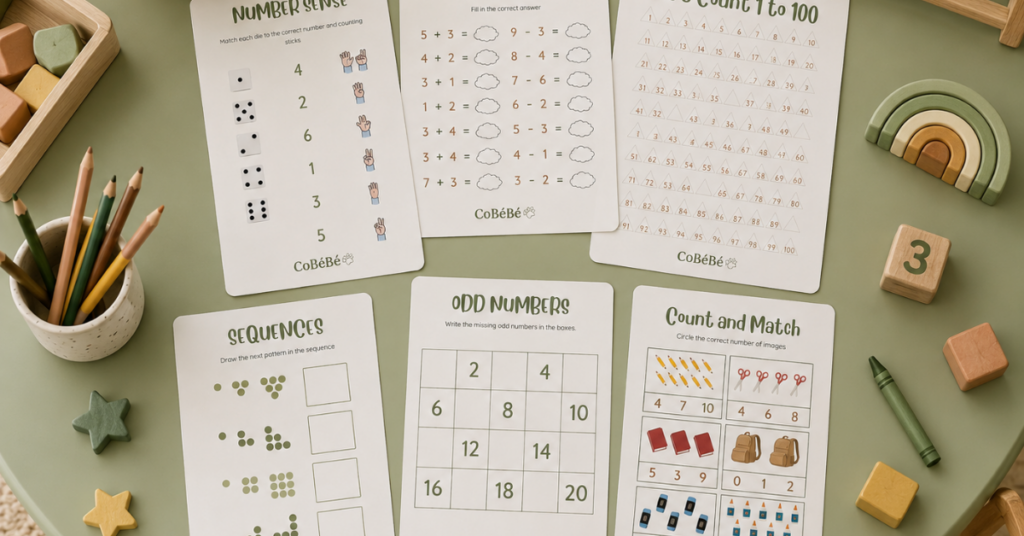
I’ve created a free number sense printable pack to make this easier to try at home.
Get the free number sense maths printables here
The pack includes simple pages for counting, number tracing, sequencing, odd numbers, addition and subtraction, count and match activities, and skip counting.
They are not meant to replace play.
They are just useful starting points.
You could print one page and leave it out with crayons. You could sit together for five minutes and talk through it. Or you could use one page alongside toys or counters to make it more hands-on.
Some days your child might be interested.
Some days they might not be.
That is fine.
At this age, the goal is not perfect worksheet completion. The goal is confidence, exposure and giving children lots of small chances to make sense of numbers.
A trusted place to read more
For a trusted source to link out to, NRICH has early years maths activities and early number sense resources that are useful for parents and educators who want to understand this topic more deeply.
The Nuffield Foundation has also funded research into preschool number foundations, including how early number skills and working memory can support later maths learning.
You do not need to read research every time you do a counting activity with your child. But it is reassuring to know that these small early number experiences are not pointless. They are part of how children build the foundations for later maths.
What number sense might look like in real life
Every child is different, so I would not use this as a strict checklist.
But in the preschool years, you may start to notice your child doing things like:
- counting small groups of objects
- recognising some numbers
- using words like more, less, bigger and smaller
- spotting simple patterns
- matching quantities to numerals
- understanding one more
- sharing items into groups
- comparing amounts
- enjoying number songs or counting books
Some children are drawn to numbers early. Others are more interested in stories, movement, building or pretend play.
That is not a problem.
You can bring number sense into all of those things.
If your child loves stories, count objects in the pictures.
If they love movement, count jumps or steps.
If they love building, count blocks.
If they love pretend play, count plates, animals, coins or cups.
You are not trying to force maths into everything. You are just showing that numbers are useful in normal life.
Keep it relaxed
One thing I would be careful with is turning every number moment into a quiz.
It is easy to do.
“What number is this?”
“How many are there?”
“What comes next?”
“Are you sure?”
A few questions are fine, but too many can make a child feel like they are being tested.
Sometimes it works better to model the thinking instead.
You could say:
“I can see three bears.”
“This pile has more.”
“I’m adding one more block.”
“That pattern goes red, yellow, red, yellow. I think yellow comes next.”
This still teaches, but it feels less pressured.
Your child can join in if they want to. If they do not, they are still hearing the language and seeing the thinking.
That counts too.
The main thing to remember
Number sense for preschoolers is not about doing formal maths early.
It is about helping children understand numbers through real, simple experiences.
Counting snacks.
Sorting toys.
Building towers.
Spotting patterns.
Tracing numbers.
Playing shops.
Matching dice to fingers.
Adding one more block.
Taking one away.
These small moments are easy to overlook because they do not look like “proper maths”. But they are exactly the kind of experiences that help children understand what numbers actually mean.
So if you are already counting, sorting, comparing and playing with your child in small ways, you are probably doing more early maths than you realise.
And if you want a simple place to start, print one number sense activity, put it out with a few crayons or counters, and keep it low-pressure.
That is usually enough for one day.
FAQ: Number Sense for Preschoolers
What is number sense for preschoolers?
Number sense for preschoolers is a child’s early understanding of numbers, amounts and how numbers work in real life. It includes skills like counting objects, recognising numbers, comparing more and less, spotting patterns, and understanding simple ideas like one more or one less.
Why is number sense important in early maths?
Number sense is important because it helps children understand what numbers actually mean, rather than just memorising number words. A strong number sense can make later maths skills like addition, subtraction, measuring and problem-solving feel more natural.
How can I teach number sense at home?
You can teach number sense at home through simple everyday activities like counting snacks, sorting toys, comparing amounts, building towers, playing shops, spotting patterns and using printable number activities. It does not need to feel like a formal maths lesson.
What age should children start learning number sense?
Children begin building number sense naturally in the toddler and preschool years. This can start through songs, counting games, play, routines and everyday conversations. Every child develops at their own pace, so the goal is gentle exposure rather than pressure.
Are number worksheets useful for preschoolers?
Number worksheets can be useful when they are simple, calm and age-appropriate. They work best when used alongside hands-on play, such as counting real objects, drawing dots, using blocks or matching numbers to physical items.