What to Start With, What to Skip, and Why It Matters
What You’ll Learn in This Guide
- What sensory play actually is (and why it’s not just messy bins and slime)
- How sensory play supports emotional regulation, focus, and learning readiness
- Simple, beginner-friendly ways to start sensory play at home — plus what to skip and why
Introduction
Sensory play is one of those terms that gets used a lot — and often misunderstood.
It’s usually talked about in terms of activities: sensory bins, messy trays, themed setups. But when you step back and really watch young children, something else becomes obvious. Sensory play is already happening, all day long.
Ever caught your child rolling out a brand new loo roll and enjoying the mess of tissue they have just created? Or maybe when they’re taking their bath and pouring water out of cups just to repeat the process over and over? A child’s day can be full of sensory experiences.
Children explore by touching, carrying, pouring, climbing, listening, repeating. They seek out sensations that help them feel grounded, calm, or alert — often without us realising that anything “educational” is happening at all.
The science backs this up. Early sensory experiences play a direct role in brain development, emotional regulation, and learning readiness. Yet many parents feel unsure where to start, what actually helps, or whether they’re doing it “right.”
This guide is here to simplify things. To explain what sensory play really is, what’s worth starting with, what’s safe to skip, and why these everyday experiences matter more than they’re often given credit for.
What Sensory Play Really Is
Sensory play is any activity that engages one or more of a child’s sensory systems:
- Touch
- Sight
- Sound
- Smell
- Taste
- Vestibular (movement and balance)
- Proprioceptive (body awareness and pressure)
These systems work together to help children interpret what’s happening around them and inside their bodies. When a child squishes dough, climbs, rocks, listens, pours, or carries something heavy, they’re not just “playing” — they’re organising their nervous system.
According to the American Occupational Therapy Association, this process is called sensory integration — the brain’s ability to take in sensory information and respond appropriately (AOTA).
Sensory play gives children safe, repeated opportunities to practise this process. And those repetitions matter.
The Science Behind Sensory Play
In early childhood, the brain is building connections at an extraordinary rate. Sensory experiences are a key driver of this growth.
The Harvard Center on the Developing Child explains that repeated, positive experiences strengthen neural pathways that support learning, emotional regulation, and physical coordination. Sensory input isn’t a “nice extra” — it’s foundational.
Sensory play also plays a role in regulation. Gentle, rhythmic sensory input — like water play, rocking, or tactile exploration — can activate the parasympathetic nervous system, often referred to as the body’s “rest and digest” system.
This is why certain activities naturally calm children. They’re not distractions — they’re biological support.
Zero to Three highlights sensory exploration as a powerful tool for helping young children manage stress, frustration, and big emotions, especially when language and impulse control are still developing.
Why Sensory Play Matters
When children engage in sensory play, they’re building skills that reach far beyond the moment itself.
Sensory play supports:
- Attention and focus – filtering information and staying engaged
- Fine and gross motor development – scooping, pouring, climbing, balancing
- Emotional regulation – processing stress and calming the nervous system
- Learning readiness – foundations for literacy, maths, and problem-solving
UNICEF notes that early play experiences help develop sequencing, memory, spatial awareness, and resilience — all of which underpin later academic learning.
In simple terms: sensory play helps children feel settled in their bodies, which frees their brains to learn.
What to Start With (Beginner-Friendly Ideas)
If you’re new to sensory play, start small. Familiar materials often work best.
Here are simple, low-pressure ways to begin:
Water play
A bowl of warm water with cups or spoons for pouring. Add a lemon slice or sponge if your child wants more variety.
Sensory walks
Barefoot time on grass, carpet, sand, or towels. Slow and simple.
Kitchen scooping
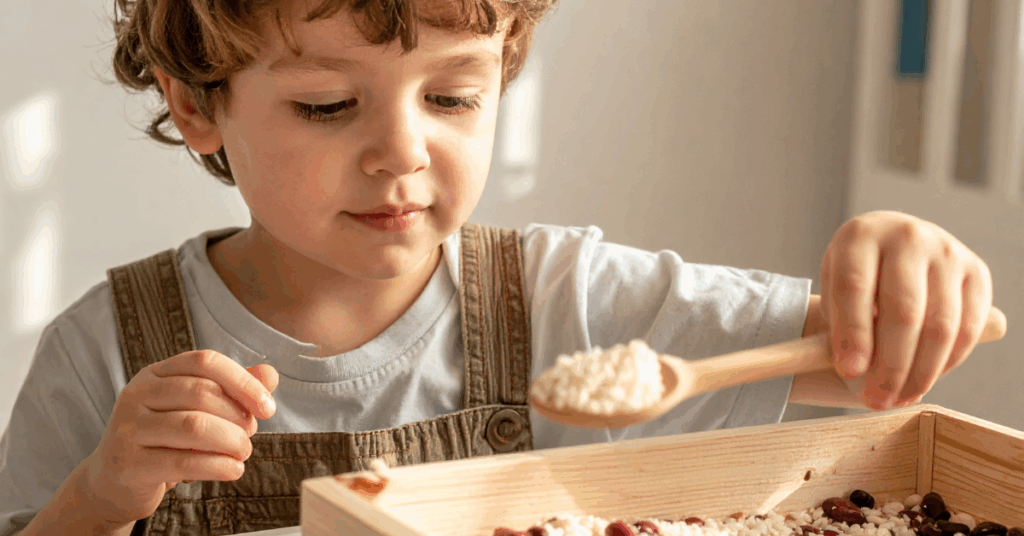
Dry rice, oats, or lentils with measuring cups. Great for fine motor control.
Nature collections
Sticks, stones, leaves, pinecones in a basket for exploring texture and weight.
Sound and rhythm
Wooden spoons, pots, homemade shakers. Listening and experimenting matters more than “music”.
None of these require special equipment. They work because they’re real, manageable, and responsive to your child.
What to Skip (and Why)
Not all sensory play supports regulation — especially for beginners.
Things to approach with caution:
- Overstimulating setups Too many colours, textures, or sounds at once can overwhelm developing nervous systems.
- Pinterest pressure Elaborate bins can shift focus from the child to the setup. Simpler often leads to deeper play.
- Mess for the sake of mess Some children love messy play. Others find it distressing. Follow your child’s cues.
- Unsafe materials Avoid choking hazards and always supervise age-appropriately (AOTA).
Sensory play should feel supportive — not stressful for you or your child.
Making Sensory Play Work in Real Life
This is where it becomes sustainable.
- Keep materials accessible and minimal
- Use what you already have at home
- Observe what calms or excites your child
- Build short sensory moments into daily routines
- Respect boundaries — avoidance is communication
Sensory play doesn’t need to last long. Five or ten minutes of meaningful input can be enough.
A Gentle Next Step
If you’d like support turning everyday moments into calming, confidence-building play, I’ve created a free Calm Play Guide with simple sensory ideas designed for real family life — not perfect setups.
You can download it here → https://cobebe.co.uk/calm-play-guide/
Further Reading & Resources
- American Occupational Therapy Association – Sensory Integration https://www.aota.org
- Harvard Center on the Developing Child – Brain Architecture https://developingchild.harvard.edu/science/key-concepts/brain-architecture/
- Zero to Three – Sensory Exploration https://www.zerotothree.org/resource/sensory-exploration/
- Action for Children – What Is Sensory Play? https://www.actionforchildren.org.uk/blog/what-is-sensory-play-and-why-is-it-important/
- UNICEF – Early Childhood Development and Play https://www.unicef.org/early-childhood-development
Conclusion
Sensory play doesn’t need to be impressive. It doesn’t need labels, trays, or plans.
It already exists in the small moments — hands in water, objects lined up, bodies moving, children concentrating in ways that feel almost quiet.
When we understand what’s happening beneath the surface, those moments stop feeling like mess or distraction. They start to feel like what they are: development in motion.
And that’s something worth noticing.