A calm, practical guide for parents with limited space (and full hearts)
Montessori Play Space Introduction
The other morning, after dropping my son off at school, I found myself chatting with another parent at the gate. We were doing that usual half-laughing, half-tired rundown of our mornings — lost shoes, forgotten water bottles, the usual chaos — when he mentioned how small his house is and how he struggles to find space for all his toddler’s toys.
He said, “I feel like I need a whole playroom just to do this Montessori stuff properly.”
I remember nodding, because I’ve felt exactly the same way. When you scroll online, Montessori play spaces often look like bright, minimalist playrooms the size of a small apartment. But most of us don’t live like that. Most of us are squeezing toys into baskets next to the sofa, sharing our living room with our child’s Lego pile, and wondering if we’re “doing it right.”
On my walk home, I was thinking about our conversation. And it reminded me of something I’ve learned over time — Montessori doesn’t require a big house, or a dedicated room, or a picture-perfect shelf. It’s really about intention, independence, and making the most of the space you do have. I wanted to explain this to him at the time, but at 8:30 in the morning the energy just wasn’t there.
So in this post, I want to share what I’ve discovered about creating a Montessori play space in a small home. The research behind it, the practical strategies, and the simple changes that make the biggest difference.
Because small homes can absolutely hold big learning.
Montessori play spaces don’t require more space. They just ask us to use the space we already have with intention.
Section 1: Why Environment Matters in Early Childhood
Maria Montessori famously said that “the child should live in an environment of beauty.”
But Montessori wasn’t talking about magazine-worthy rooms—she was talking about environments that support independence, calm, and meaningful exploration.
Modern research backs this up.
According to the Harvard Center on the Developing Child, early environments literally shape the architecture of the brain. Predictable, accessible, and thoughtfully prepared spaces help build executive function, emotional regulation, and concentration.
Source: https://developingchild.harvard.edu
Young children also learn through their senses. Too much clutter, noise, or choice overwhelms their still-developing systems. Zero to Three notes that busy or disordered environments increase stress and reduce the ability to focus.
Source: https://www.zerotothree.org
A Montessori play space—simple, ordered, and calm—helps reduce that overload and invites deeper, more meaningful play.
Section 2: What Makes a Montessori Play Space (Even in a Small Home)
You don’t need a big house to apply Montessori principles. You just need clarity and intention.
Core principles:
- Simplicity — fewer toys, deeper play
- Order — predictable layout children can navigate on their own
- Beauty — natural materials, soft lighting, calm colours
- Accessibility — everything at the child’s level
- Real-life relevance — materials that connect to daily life
- Rotation — only 6–8 toys out at once
- Child-sized design — shelves, tools, and furniture they can use independently
Small Montessori play spaces naturally encourage these principles—because simplicity becomes a necessity, not an aesthetic.
Section 3: The Science Behind Small, Intentional Spaces
A fascinating study from the University of Toledo found that children in rooms with fewer toys played longer and more creatively than those surrounded by many options.
Study link: https://pubmed.ncbi.nlm.nih.gov/29219355/
The reason?
When there’s less to choose from, children dive deeper.
Zero to Three highlights that cluttered or overstimulating spaces confuse a child’s attention system, making it harder to settle into focused play.
Source: https://www.zerotothree.org
So yes, your small home is not a limitation—it’s an advantage.
Section 4: Common Misconceptions About Montessori Play Spaces at Home
❌ “I need a big house to do Montessori.”
✅ Montessori thrives in small, intentional spaces.
❌ “I need expensive wooden toys.”
✅ Useful, real-life objects often work even better.
❌ “It needs to look like Pinterest.”
✅ Montessori is about function, not aesthetic performance.
❌ “Montessori means no fun toys.”
✅ Montessori encourages joyful learning—it just removes overwhelm.
Section 5: Practical Small-Space Solutions
These ideas work beautifully in tight spaces:
1. Use Vertical Space
Pegboards, hooks, mounted shelves—great for storing materials without eating floor space.
2. Create Micro-Zones
A reading basket by the sofa.
A small tray of pouring tools near the kitchen.
A mat that signals “this is where we work.”
Small areas can hold big purpose.
3. Rotate Toys
Keep 6–8 items out. Store the rest.
This instantly creates calm and clarity.
4. Low Shelves
Even one small, open shelf can function as your “Montessori play space corner.”
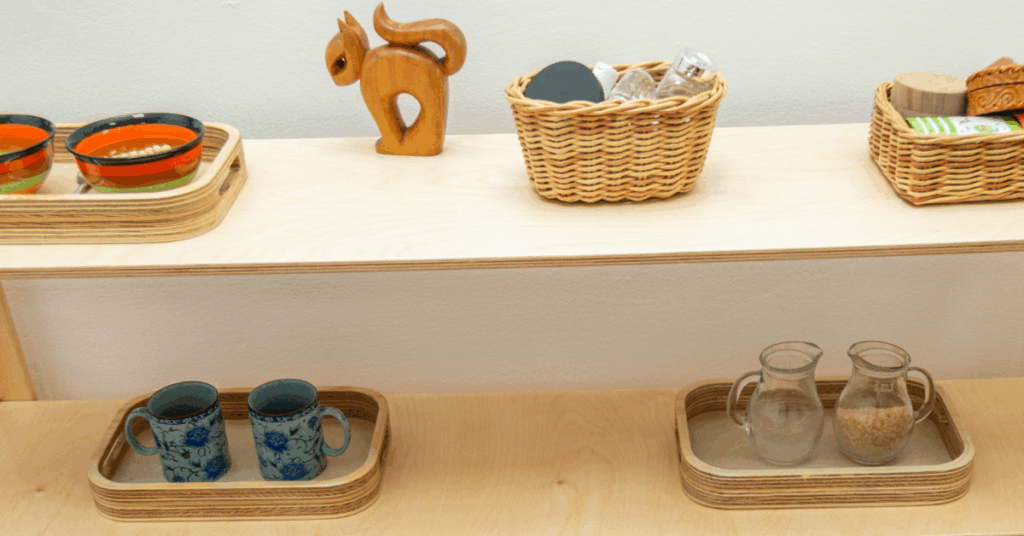
5. Baskets & Trays
They define activities and keep materials inviting.
6. Child-Height Everything
Hooks, cups, tools, books—if they can reach it, they can use it independently.
7. Multi-Purpose Furniture
A cube shelf becomes a bench.
A folding table becomes an art station.
8. Environmental Cues
A small rug signals a workspace.
A basket invites quiet reading.
A mirror encourages dressing independence.
Section 6: Montessori Materials That Work in Small Homes
Look for items that are:
- Open-ended (blocks, stacking cups, figurines)
- Purposeful (child-safe kitchen tools)
- Sensorial (items that isolate shape, texture, weight)
Small favourites include:
- A lacing/bead threading set
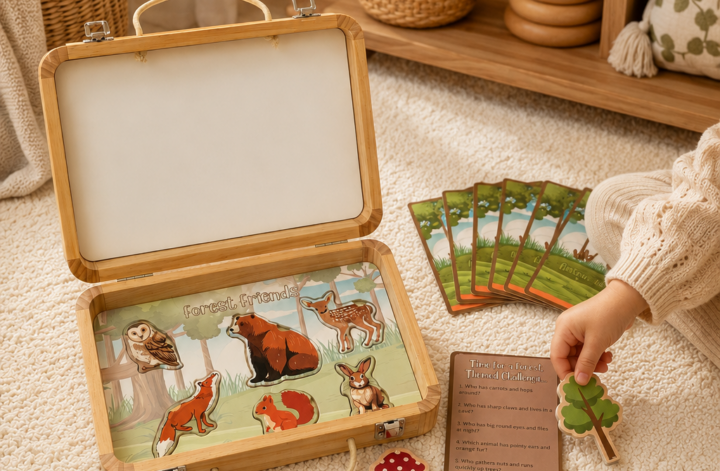
- A discovery basket of natural objects
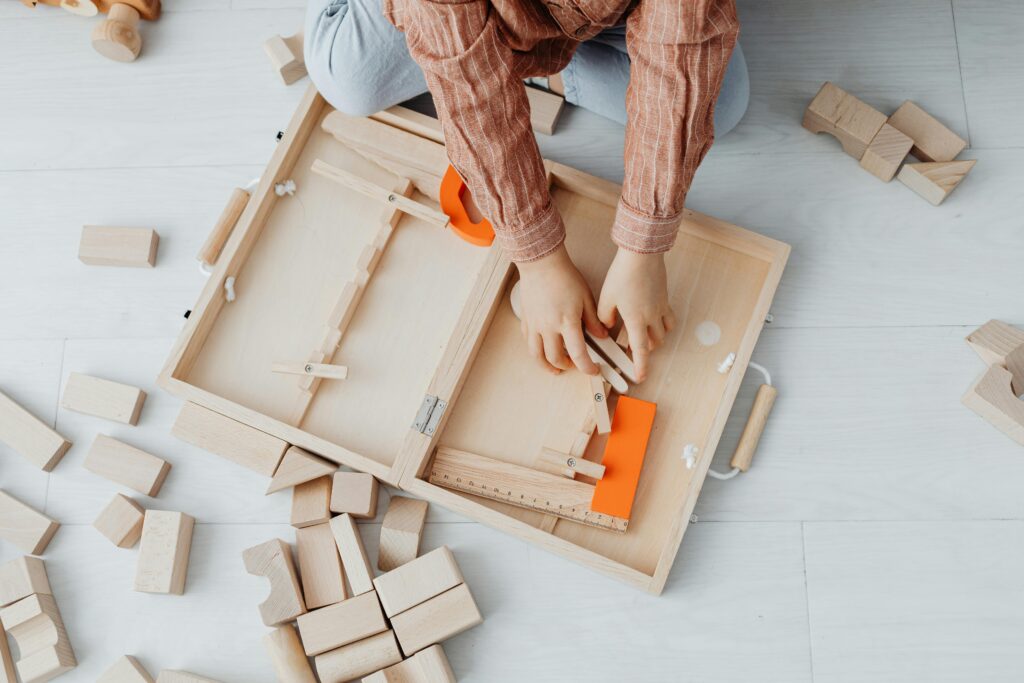
- Wooden blocks
- Mini practical-life tools
- A small forward-facing book rack
“Fewer, better” is the rule.
Section 7: Montessori in Your Daily Rhythm (Not Just on a Shelf)
Montessori is a way of living—not a corner of your room.
Try:
- A low hook by the door for your child’s coat
- A snack station they can access
- Mini cleaning tools they can actually use
- A floor mirror near their dressing area
- Gentle routines like “one activity at a time”
Small-space Montessori is incredibly doable when woven into daily life.
Where to Find Montessori-Friendly Furniture in the UK (Helpful Resources)
One of the first questions I had when looking into this was: “Where can I actually buy the child-sized furniture — things like low shelves, little tables, and baskets?”
The good news is that you don’t need a huge budget or a big house. There are some great UK-based options that offer small-space-friendly, Montessori-aligned pieces.
Here are a few trusted places to start exploring:
Goodevas UK
Beautiful, sturdy Montessori-style furniture made from natural materials. They offer low shelves, toddler towers, step stools, and small activity chairs that work really well in compact homes.
Petite Amélie
A lovely range of child-sized tables and chairs, bookcases, and simple wooden storage pieces. Their smaller table sets fit well into living rooms or kitchen corners.
https://www.petiteamelie.co.uk
TreeTale UK
Offers Montessori-inspired storage units, shelves, and child-height furniture. Good for families wanting modular pieces they can rearrange as their child grows.
https://treetale.uk/product-category/childrens-furniture/montessori-furniture
The Montessori Family (UK Resource List)
Not a shop, but a helpful directory listing different Montessori furniture suppliers across the UK — great if you want to browse around or compare styles.
https://themontessorifamily.com/where-to-find-montessori-furniture-in-the-uk
Section 8: Free Resource to Help You Get Started
If you’d like gentle, Montessori play space wall art and calm, independent play resources, I’ve created a free library for you on our website. They include:
- Learning, wall artwork
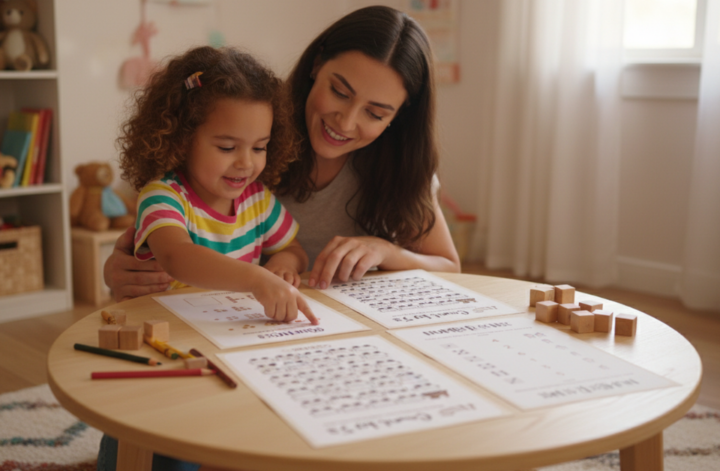
- Alphabet tracing sheets
- Independence-building routines
- Counting games bundle
You can download them here → https://cobebe.co.uk/free-printables/
Section 9: Further Reading & Resources
- Harvard Center on the Developing Child — https://developingchild.harvard.edu
- Zero to Three — https://www.zerotothree.org
- Dauch et al. (2018) — https://pubmed.ncbi.nlm.nih.gov/29219355/
- Guidepost Montessori – https://guidepostmontessori.com/blog/the-ultimate-guide-to-montessori-at-home
- Miraculove Small Apartment Montessori Setup — https://miraculove.com/How_I_Montessori_My_Small_500_sqft_Apartment_to_be_Child_Friendly
- Montessori-Style Learning Space at Home — https://sunnydaysboise.com/creating-a-montessori-style-learning-space-at-home
- Mama’s Happy Hive — https://www.mamashappyhive.com/montessori-spaces-in-our-home/
Conclusion
You don’t need a playroom.
You don’t need more space.
You don’t need the “perfect” Montessori setup.
You just need intention—and a belief that your child is capable.
Small homes can absolutely hold big opportunities for independence, creativity, and calm. With thoughtful choices and a gentle rhythm, you can create a space where your child can explore, focus, and grow… even if it’s just a corner of your living room.
You’re doing more than enough. Montessori begins exactly where you are.