“Fewer, better toys” is the idea that children thrive with a small number of high-quality, meaningful toys, rather than shelves full of clutter. It’s based on the understanding that young children play deeper, calmer, and more creatively when they’re not overwhelmed by too many choices.
It isn’t about owning expensive toys or creating a minimalist home. It’s about choosing toys with intention — items that spark curiosity, last well, and support real learning.
Why Fewer, Better Toys Matter
1. Less overwhelm, more focus
When children have fewer toys in front of them, they can concentrate better and engage for longer without bouncing from one thing to another.
2. Higher-quality play
Well-made, open-ended toys invite creativity and imagination. They lead to richer play experiences than toys that light up, talk, or direct the play.
3. Easier for children to tidy and manage
A calmer play space means children can take care of their things more independently — a big Montessori principle.
4. Encourages deeper learning
Children return to meaningful toys again and again, exploring new ideas each time.
5. Saves money long-term
Investing in a few durable toys reduces constant purchases of cheaper items that get ignored or break quickly.
Examples of “Better” Toys
“Better” doesn’t mean complicated. It usually means:
- open-ended
- durable
- made from natural or high-quality materials
- simple in design
- calming to look at
- versatile across ages
- safe and long-lasting
Examples include:
- wooden blocks
- puzzles
- figurines and animals
- stacking toys
- loose parts
- nature materials
- simple art supplies
- matching or sorting games
- magnetic pieces
- tactile objects
These toys grow with the child, instead of being used for a week and forgotten.
Examples of “Fewer” Toys
Most families find 8–12 toys out at one time is enough. The rest can be stored and rotated when interest fades.
This supports calmer play and aligns perfectly with toy rotation systems.
How to Practise “Fewer, Better Toys” at Home
- Choose toys that encourage imagination and exploration
- Rotate toys weekly or when interest drops
- Keep play shelves simple and uncluttered
- Prioritise open-ended items over noisy, flashing toys
- Add nature materials (leaves, stones, sticks) for variety
- Notice what your child consistently returns to — these are your “better” toys
No aesthetic perfection needed — just intention.
Fewer, Better Toys and CoBéBé
CoBéBé was built around this idea.
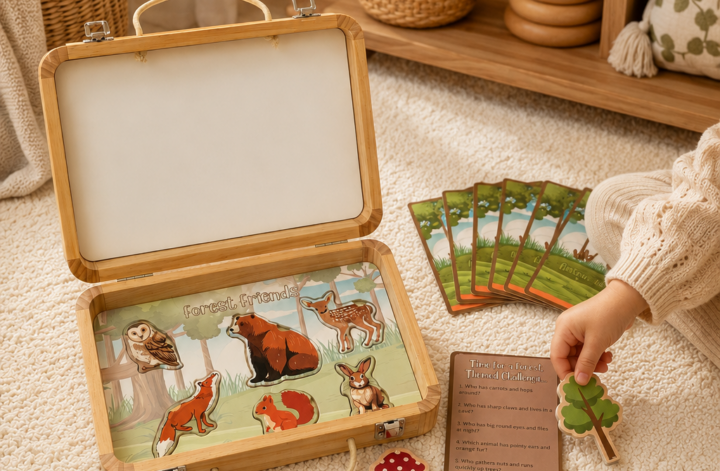
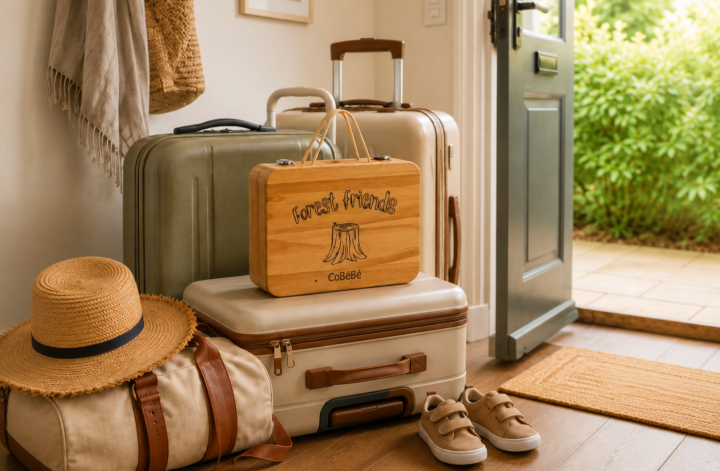
Our Forest Friends activity box is designed to be one thoughtful toy that offers many ways to play, instead of needing dozens of single-purpose toys.
Because it includes a puzzle, magnetic pieces, animal cards, storytelling prompts, and a creative drawing surface, it replaces multiple toys while keeping play calm, open-ended, and high quality.
It’s the kind of toy that earns its place on the shelf.