In this article, you’ll learn:
- Montessori vs Traditional Toys, what’s the real difference — beyond aesthetics and marketing labels
- What research says about how children actually learn through play, and why toy design matters
- How to choose toys more intentionally, without guilt, pressure, or throwing everything out
Why This Question Feels So Relevant Right Now
It’s the first week of January. The Christmas decorations are slowly coming down, routines are trying to re-establish themselves, and the living room is still quietly crowded with new toys.
Some have already been played with endlessly. Others — if we’re honest — were exciting for about ten minutes before being forgotten.
After putting the kids to bed – now the return to school is approaching, me and my partner were rearranging the front room when we had a familiar conversation. “They don’t seem interested in this one,” “this is getting overwhelming,” “where is this going to get stored,” “do you think those wooden Montessori toys are actually better — or is it just a trend?“
It was that last question that I wanted to answer, not just for my partner, but for other parents too. Especially after Christmas, when toys are fresh in our minds and the marketing noise has been loud.
So rather than another opinion piece or parenting debate, I wanted to look deeper into what’s really behind the difference — not what toys look like, but what they ask of a child’s brain, body, and attention.
How Children Actually Learn Through Play
Before comparing toys, it helps to understand how learning happens in early childhood.
According to the American Academy of Pediatrics, play is not optional — it’s essential for healthy brain development, emotional regulation, language, and social skills.
But not all play engages the brain in the same way.
Attention & Focus
Young children are still developing sustained attention. Simple, engaging materials — without constant noise or visual overload — help strengthen this skill over time.
🔗 https://developingchild.harvard.edu/science/key-concepts/executive-function/
Sensory Processing
Children learn through their senses. Too much stimulation at once (lights, sounds, movement) can overwhelm their nervous system, making focus and regulation harder.
🔗 https://www.zerotothree.org/resource/play-is-the-work-of-the-child/
Motor Development
Hands-on, repetitive movement builds fine and gross motor skills — especially when the child, not the toy, is doing the work.
Executive Function
Problem-solving, self-control, and flexible thinking grow when children can explore independently and repeat activities at their own pace.
🔗 https://developingchild.harvard.edu/science/key-concepts/executive-function/
This is where toy design begins to matter.
What Montessori Toys Are Designed to Do
Montessori-aligned toys are rooted in the work of Dr. Maria Montessori, whose philosophy centred on independence, concentration, and respect for the child.
In practice, Montessori toys tend to share a few key traits.
Simplicity & Purpose
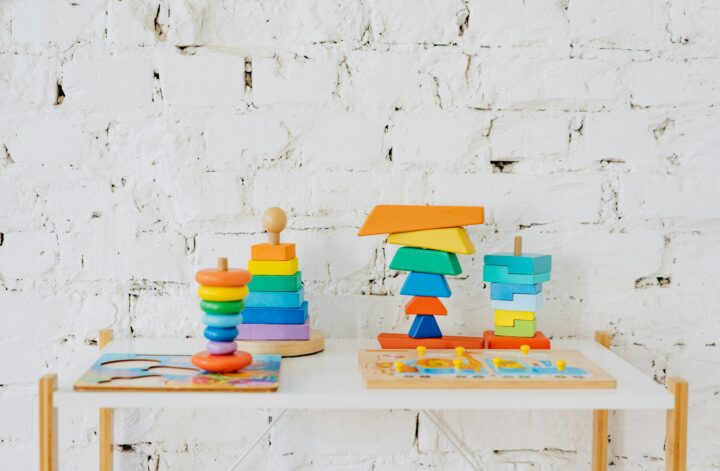
Most Montessori toys focus on one clear skill at a time — stacking, threading, matching, pouring. This supports deep focus and mastery through repetition.
🔗 https://montessorigeneration.com/blogs/montessori/montessori-toys-vs-traditional-toys
Reality-Based Play
Instead of fantasy characters or pre-scripted stories, Montessori toys often mirror real life — cooking, cleaning, building, sorting. This helps children understand and participate in their world.
🔗 https://jabaloo.com/blogs/education/montessori-vs-traditional-toys-understanding-the-key-differences
Independence & Intrinsic Motivation
Many Montessori toys are self-correcting — the child can see when something doesn’t work and try again without adult input. This builds confidence and internal motivation.
🔗 https://woodandhearts.com/blogs/news/benefits-montessori-toys
What Traditional Toys Are Designed to Do
Traditional toys aren’t “bad” — but their design priorities are often different.
Entertainment-Driven Features
Lights, sounds, songs, and buttons are designed to capture attention quickly. But this can lead to passive play, where the toy leads and the child reacts.
🔗 https://www.zerotothree.org/resource/play-is-the-work-of-the-child/
Adult-Led Play
Many toys require instruction, rules, or demonstrations, which can limit independent exploration.
Short-Term Novelty
When interest is driven by surprise or sound, engagement can fade quickly once the novelty wears off — often leading to toy clutter rather than sustained play.
Why the Difference Actually Matters
The difference isn’t about aesthetics. It’s about how children experience play.
- Focus: Simpler toys support longer attention spans
- Creativity: Open-ended materials invite imagination and problem-solving
- Emotional Regulation: Calm, self-directed play helps children settle and self-regulate
- Independence: Toys a child can use alone build confidence and capability
This doesn’t mean traditional toys never have a place. It means balance — and awareness.
Common Questions Parents Have About Toys
Let’s clear a few things up.
Are Montessori toys boring?
They can look simple — but when matched to development, they’re deeply engaging.
Are traditional toys harmful?
Not inherently. The issue is over-reliance, not occasional use.
Are all wooden toys Montessori?
Material alone doesn’t define Montessori. Design and purpose matter more.
Do “educational” labels guarantee learning?
Learning comes from how a toy is used, not what the box claims.
How to Choose Toys More Intentionally
Next time you’re shopping — or decluttering — try asking:
- Does the toy do the work, or does my child?
- Is it open-ended or single-use?
- Can my child use it independently?
- Does it support focus or fragment attention?
- Will it grow with them?
Observation is your best guide. Toys children return to — and use in different ways — are usually the ones doing the most developmental work.
If You’re Feeling Toy Overwhelmed
If Christmas has left your home feeling louder, fuller, or more chaotic than usual, you’re not alone. Many parents find that the hardest part isn’t the toys themselves — it’s knowing which ones actually support calm, focused play.
If you’d like help creating a gentler rhythm at home, I’ve put together a free Calm Play Guide. It’s designed to help you step away from overstimulation and focus on simple, meaningful play that supports attention, regulation, and independence — without needing more stuff.
👉 Download the Calm Play Guide here Calm Play Guide
It works whether you’re Montessori-curious or simply craving a calmer play space after the Christmas rush.
Further Reading & Resources
- Harvard Center on the Developing Child – Executive Function https://developingchild.harvard.edu/science/key-concepts/executive-function/
- American Academy of Pediatrics – The Power of Play https://publications.aap.org/pediatrics/article/142/3/e20182058/38649
- Zero to Three – Play Is the Work of the Child https://www.zerotothree.org/resource/play-is-the-work-of-the-child/
- Montessori Generation – Montessori vs Traditional Toys https://montessorigeneration.com/blogs/montessori/montessori-toys-vs-traditional-toys
- Wood and Hearts – Benefits of Montessori Toys https://woodandhearts.com/blogs/news/benefits-montessori-toys
- Tiny Land – Montessori Toys vs Regular Toys https://www.tinylandus.com/blogs/collections/what-is-the-difference-between-montessori-toys-and-regular-toys
Closing Thoughts
Toys are just tools. The real magic comes from a child’s curiosity, focus, and desire to explore.
Montessori isn’t about doing things “right.” It’s about being intentional — choosing fewer, better tools that support how children naturally learn.
If this post helps you see your child’s toys a little differently, then it’s done its job.
You’re already paying attention. And that matters more than any toy ever could.