
What You’ll Learn in This Article
- Typical attention span by age — realistic focus ranges for toddlers, preschoolers and young children.
- How play strengthens concentration and brain development in the early years.
- Practical ways parents can support longer attention spans through calm environments and open-ended play.
Why Attention Spans Aren’t What Most Parents Think
If you search online for attention span by age, you’ll usually find neat little charts telling you how long children “should” focus.
Two-year-olds: a few minutes.
Four-year-olds: maybe fifteen.
School-age children: longer.
On paper it sounds simple.
But real life with children rarely looks like a tidy chart.
One afternoon recently I watched something that made those numbers feel a bit meaningless. My youngest sat quietly with a handful of toy cars, sliding them back and forth along the rug. No instructions. No rush. Just slow, careful repetition.
Meanwhile, across the room, their sibling moved between three different activities in the same ten minutes — colouring, blocks, then a puzzle.
Two children. Same house. Same toys.
Completely different patterns of focus.
That moment made me curious enough to dig into the research properly — and what I found was reassuring.
Attention span in early childhood isn’t just about age.
It’s shaped by brain development, environment, the type of play children engage in, and the way activities invite (or interrupt) deep focus.
Once you understand that, a lot of parenting worries suddenly start to soften.
Understanding Attention Span by Age
Attention span is the amount of time a child can concentrate on a task before becoming distracted.
But in young children, that ability is still developing.
One commonly cited guideline suggests children can focus for roughly three to five minutes per year of age.
That means:
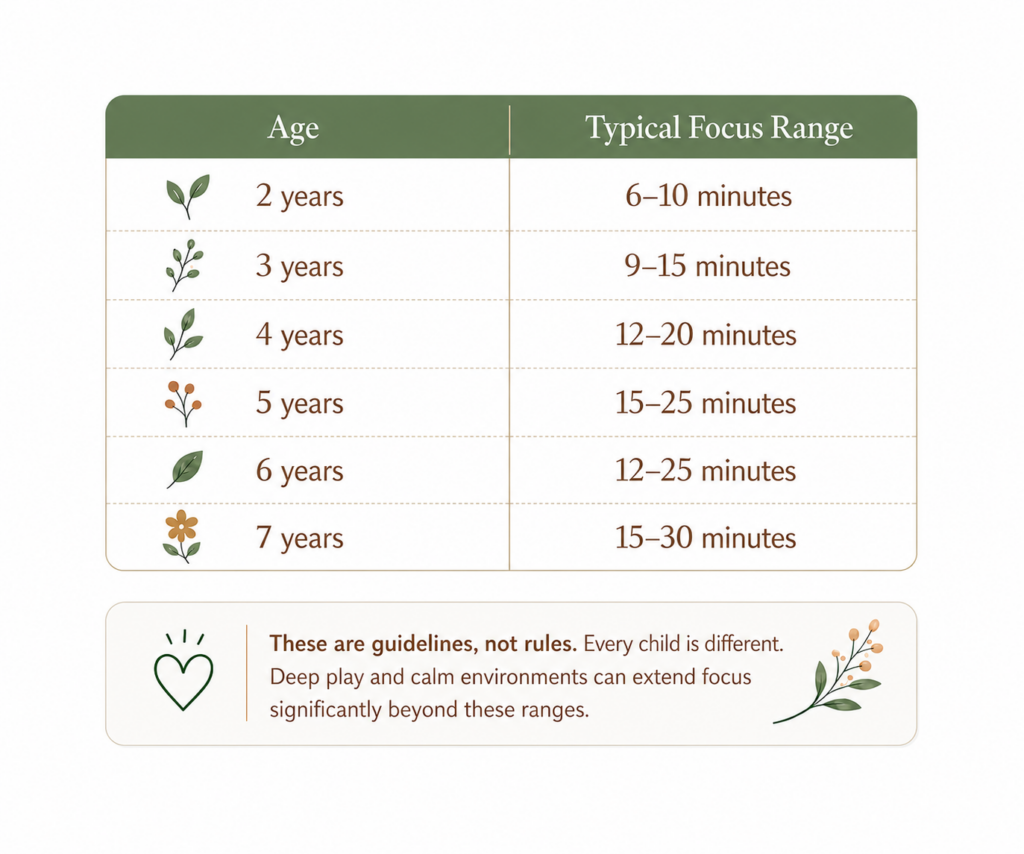
(Source: TEIS Early Intervention, 2022; Happiest Baby, 2022)
Of course, these are guidelines, not rules. Personality, environment and sleep all influence attention.
But for many parents, simply seeing these numbers can be incredibly reassuring.
A three-year-old bouncing between activities every ten minutes?
That’s often completely normal.
What’s Happening in a Child’s Brain
During early childhood, the brain is developing at an astonishing pace.
Researchers at the Harvard Center on the Developing Child explain that neural connections are formed through repeated experiences, shaping what they call brain architecture.
https://developingchild.harvard.edu/science/key-concepts/brain-architecture
One of the key areas still developing is the prefrontal cortex — the part of the brain responsible for:
- attention
- planning
- problem solving
- impulse control
These abilities are known as executive function skills, and they are fundamental for learning later in life.
But they don’t mature quickly.
Executive function continues developing well into adolescence.
Which means expecting long focus from a toddler is a bit like expecting a seedling to behave like a tree.
It will get there.
But slowly.
How Play Builds Attention Over Time
This is where things get fascinating.
Play isn’t just entertainment.
It’s how the brain practices focus.
Repetition Strengthens Neural Pathways
Have you ever watched a child repeat the same action over and over?
Pouring water.
Stacking blocks.
Knocking down a tower.
Repetition may look boring to adults, but it’s how children build mastery.
Each repetition strengthens neural connections that support memory, coordination and attention.
The UNICEF parenting guide on play highlights that playful exploration is essential for cognitive development.
https://www.unicef.org/parenting/child-development/play
Deep Play Builds Longer Focus
Sometimes children enter what psychologists call deep play.
This is when they become fully absorbed in an activity — building, imagining, sorting, constructing.
During these moments:
- time passes unnoticed
- attention naturally lengthens
- creativity flourishes
You’ve probably seen it.
The quiet child talking to themselves while building a tower.
The preschooler lost in a pretend story.
That’s the brain practising focus.
Why Some Toys Shorten Attention
Interestingly, not all toys support focus equally.
Many modern toys are designed to grab attention quickly through:
- flashing lights
- sound effects
- automatic actions
These features can create short bursts of excitement, but they often reduce sustained engagement.
In contrast, open-ended toys — blocks, puzzles, art supplies, figurines — encourage children to create their own play.
This type of play:
- requires problem solving
- encourages imagination
- naturally extends attention span
Sometimes the simplest toys are the most powerful.
Healthy Short Attention vs Attention Difficulties
It’s important to say this clearly:
Short attention spans in young children are normal.
Moving between activities, needing reminders, or losing focus easily are typical parts of development.
However, persistent attention difficulties that affect learning, behaviour or relationships may sometimes need professional guidance.
The NHS suggests speaking with a health professional if concerns about focus consistently affect daily life.
https://www.nhs.uk/conditions/attention-deficit-hyperactivity-disorder-adhd
Most of the time though, children simply need time.
How Parents Can Support Better Focus
You can’t force concentration.
But you can create conditions that support it.
Here are a few gentle shifts that help.
Reduce Toy Overload
Too many toys can overwhelm a child’s brain.
A smaller selection often encourages deeper play.
Create Calm Play Spaces
A defined play area with minimal distractions can improve focus dramatically.
Choose Open-Ended Materials
Blocks, drawing supplies, puzzles and figurines invite creativity and problem solving.
Allow Repetition
Repeating the same activity is not boredom.
It’s learning.
Protect Deep Play
If your child is deeply focused, try not to interrupt.
These moments are incredibly valuable.
FAQ: Attention Span by Age
How long should a toddler focus on one activity?
A rough guideline is three to five minutes per year of age. For example, a two-year-old may focus for around 6–10 minutes.
Why does my child move quickly between activities?
Young children explore the world through curiosity. Switching activities is a normal way of learning and experimenting.
What activities help improve attention span?
Open-ended activities such as building blocks, drawing, puzzles and imaginative play support longer engagement.
Do screens affect attention span?
Highly stimulating screen content can shorten attention for slower activities, so balancing screen time with hands-on play is important.
Should I worry if my child struggles to focus?
Short attention spans are developmentally normal. If focus difficulties consistently impact learning or behaviour, speaking with a health professional may help.
A Gentle Next Step for Parents
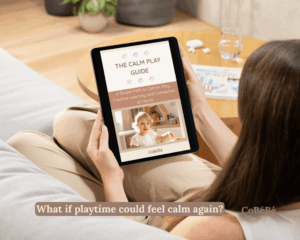
If you’d like more ideas for encouraging calm, focused play at home, I’ve created a free Calm Play Guide filled with simple activities that support concentration, creativity and independent play.
And soon I’ll be sharing something I’ve been quietly developing behind the scenes — a wooden play activity called Forest Friends, inspired by everything I’ve learned about deep, open-ended play for young children.
If that sounds interesting, you’re very welcome to join the mailing list to hear when it’s ready.
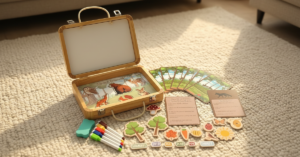
We also have a free Printables Collection – simple, beautiful activity sheets and posters to print, play and enjoy at home.

Final Thoughts
Looking back at that rainy afternoon, the difference between my children’s play doesn’t worry me anymore.
One explored widely.
One focused deeply.
Both were learning.
Attention doesn’t grow in a straight line.
It grows through play, curiosity, repetition and time.
And sometimes the quietest moments on the living room floor are where the biggest brain changes are happening.