A research-backed guide for real life
What you’ll learn in this guide
- How calm play activities support your child’s brain development, emotional regulation, and focus
- Simple, low-effort calm play activities that fit into busy days (even 5–15 minute windows)
- What to skip — and why overstimulating toys and rushed play can backfire
The Moment We All Know Too Well
It was one of those in-between moments— not quite playtime, not quite bedtime. I was sat on the sofa replying to messages, half listening to the noise in the background, when my toddler climbed up beside me and quietly said, “Can we do something together?”
Not a game. Not a big activity. Just something.
I remember feeling stuck. I didn’t have the energy for imaginative role play or a big setup. I also didn’t want to default to a screen, knowing it would only buy me a few distracted minutes before the mood shifted again.
That’s when I started paying closer attention to what actually worked in our home on busy days — the small, quiet moments that helped my children settle, focus, and feel connected without needing much from me at all.
What I found was reassuring: calm play doesn’t require time we don’t have. It doesn’t ask us to perform. And it doesn’t compete with real life — it fits inside it.
This guide brings together research, practical examples, and real-world parenting to show how calm play can support your child’s development and your sanity — even when life feels full.
What Calm Play Really Is (and What It Isn’t)
Calm play isn’t about silence, stillness, or “good behaviour.”
It’s about regulated engagement — activities that allow your child to focus, explore, and settle into play without overwhelming their nervous system.
Unlike fast-paced screen content or noisy electronic toys, calm play supports what researchers call a regulated state, where the brain is calm enough to learn, connect, and problem-solve.
Think:
- Focused, not frantic
- Engaged, not overstimulated
- Curious, not chaotic
Calm play activities often look deceptively simple — and that’s exactly why it works.
The Science Behind Calm Play
When children feel calm and regulated, their brains are more open to learning.
According to the Harvard Center on the Developing Child, regulated states support the development of executive function skills — attention, memory, emotional control, and flexible thinking. These skills are foundational for learning and wellbeing, both now and later in life.
🔗 https://developingchild.harvard.edu/science/key-concepts/executive-function/
In contrast, overstimulation can push children into a stress response, making it harder to focus, cooperate, or transition between activities. Zero to Three explains that young children need predictable, soothing experiences to help their nervous systems settle.
The American Academy of Pediatrics also highlights the importance of play that supports sensory integration — the brain’s ability to organise sensory input and respond appropriately. Calm, hands-on play is a key part of that process.
In simple terms: calm play activities help children feel safe enough to learn.
Why Calm Play Activities Matter for Busy Families
Here’s the part that surprised me most: calm play often leads to more independence, not less.
When children are regulated, they:
- Play for longer
- Transition more easily
- Cope better with frustration
- Need less constant adult input
Research from NAEYC shows that responsive, low-stress play strengthens emotional regulation and parent-child connection — especially when it’s unhurried and attuned.
For busy families, this matters. Calm play isn’t another thing to manage — it’s a way of smoothing the day.
The Best Calm Play Activities for Busy Parents
These ideas are intentionally:
- Low-prep
- Low-mess
- Short-window friendly
1. Water Play (Bowl or Sink)
Why it helps: Water provides calming sensory input and supports fine motor skills.
How: A bowl of warm water, a few cups or spoons. That’s it.
🔗 Sensory regulation: https://www.zerotothree.org
2. Sticker Scenes or Reusable Sticker Books
Why it helps: Builds focus, coordination, and quiet concentration.
How: Keep them for transitions or end-of-day decompression.
3. Play Dough with Simple Tools
Why it helps: Strengthens hands and supports sensory integration.
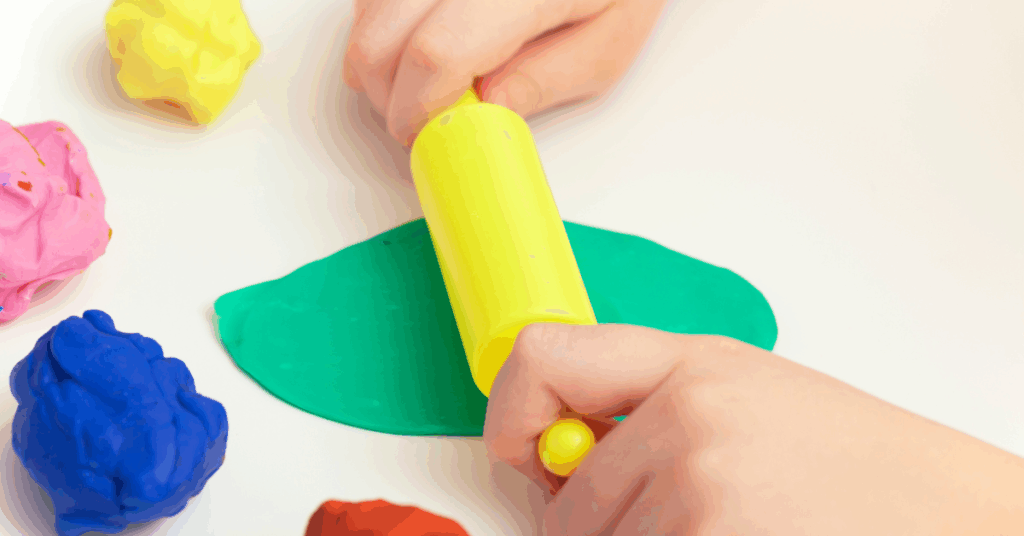
How: Dough + spoon, shell, or cutter = calm engagement.
4. Calm Jar Observation
Why it helps: Slow visual tracking supports emotional regulation.
How: Shake, watch, breathe. No instruction needed.
5. Sorting & Matching
Why it helps: Builds early maths skills and executive function.
How: Buttons, stones, or blocks sorted by size or colour.
6. Gentle Music + Drawing
Why it helps: Combines soothing auditory input with creative focus.
How: Soft music, paper, crayons — nothing fancy.
7. Puzzle Time
Why it helps: Encourages sustained attention and problem-solving.
How: Keep a few familiar puzzles accessible.
What to Skip (and Why)
Not all “play” supports regulation.
Research suggests avoiding:
- Flashing lights & loud sounds — can dysregulate young nervous systems (AAP)
- Too much novelty — overwhelms attention (Harvard)
- Rushed transitions — increase stress responses (Zero to Three)
- Screens before calm play — can reduce focus afterwards (UNICEF) 🔗 https://www.unicef.org/early-childhood-development
Making Calm Play Work in Real Life
What’s helped most in our home:
- A small calm basket with rotating favourites
- Using natural pauses in the day (after school, before dinner)
- Sitting nearby instead of entertaining
- Repeating the same activities — familiarity builds focus
Calm play activities work best when it’s predictable and pressure-free.
A Gentle Invitation
If you’d like support turning calm play into something that fits your real life, I’ve created a free Calm Play Guide with simple setup ideas, and rhythms for busy families.
You can download it here → Calm Play Guide
No pressure. Just support.
Further Reading & Research
- Harvard Center on the Developing Child – Executive Function https://developingchild.harvard.edu
- Zero to Three – Emotional Regulation in Young Children https://www.zerotothree.org
- American Academy of Pediatrics – Choosing Appropriate Toys https://www.aap.org
- UNICEF – Play and Early Brain Development https://www.unicef.org/early-childhood-development
- NAEYC – Quality Time and Child Development https://www.naeyc.org
Calm play isn’t about doing more.
It’s about recognising that children don’t always need more stimulation — they often need less, delivered with intention.
When we offer small, steady moments of calm, we’re supporting our children’s brains, emotions, and sense of safety. And in doing so, we often find a little more calm for ourselves too.
That’s not a parenting ideal.
That’s something we can actually live with.