A Science-Based Breakdown for Parents
What You’ll Learn in This Article – What Makes a Toy Educational?
- How children actually learn through play — and what types of toys genuinely support brain development.
- The research-backed differences between educational and entertaining toys (and why many labels are misleading).
- Simple, practical criteria for choosing toys that support focus, creativity, and independence — without buying more.
Why “Educational” Toys Are So Confusing
Not long ago, I found myself in a toy shop holding two very different boxes.
One promised 100+ words, lights, music, and interactive learning. The other was just… a plain wooden set. No screens. No claims. No buttons.
One looked educational.
The other looked quiet.
At home, I’ve noticed the same pattern. Some toys light up, talk, and seem impressive at first — then sit untouched. Meanwhile, a cardboard box becomes a spaceship for days. A pile of blocks turns into a zoo, a tower, a road, and a story.
It made me curious: what makes a toy educational?
Is it the features? The price tag? The “STEM” label?
So I went digging — into child development research, pediatric guidance, and studies on toy design. What I found was both surprising and reassuring:
The toys that support learning best are often the simplest.
Here’s what the science really says about how children learn through play — and how to choose toys that truly support that learning.
How Children Actually Learn Through Play
Play isn’t just entertainment. It’s how the brain develops.
According to the American Academy of Pediatrics, play builds the skills children need to thrive, including language, emotional regulation, executive function, and social development.
But how children play matters.
Attention & Focus
Children develop sustained attention through activities that invite deep, uninterrupted engagement. Toys like puzzles, building sets, and pretend play encourage longer focus than toys with constant lights or sounds. Research shows that simpler toys promote better attention and self-regulation (Christakis et al., 2009).
Repetition & Mastery
Children repeat actions — stacking, sorting, knocking down, trying again. This repetition strengthens neural pathways and builds mastery. Toys that allow experimentation support this far more than toys that “do everything” with a button.
Sensory Processing & Motor Skills
Handling different textures, weights, and shapes builds sensory and motor integration — essential for writing, dressing, and everyday coordination. A 2023 review on educational toy design found that balanced sensory input supports deeper learning than overstimulation.
👉 https://www.sciencedirect.com/science/article/pii/S2352146523000461
Language Development
Play is one of the richest contexts for language growth. When children pretend, narrate, and ask questions, vocabulary and communication flourish. Open-ended toys encourage far more language than closed, pre-programmed toys.
👉 https://dl.tufts.edu/concern/pdfs/6h440s418
Executive Function
Problem-solving, memory, flexible thinking, and self-control are built through child-led play that requires planning and adjustment — like rebuilding a tower after it falls.
The Science of What Makes a Toy Educational
Across multiple studies, five features consistently show up in toys that truly support learning:
1. Active Engagement
Educational toys invite children to do something — build, sort, pretend, ask, create. This “minds-on” learning helps children construct meaning rather than passively receive information.
👉 https://journals.sagepub.com/doi/10.1177/0956797617751403
2. Simplicity & Focus
A 2017 study found toddlers played more creatively and for longer when given fewer toys, suggesting that too many features overwhelm attention.
👉 https://www.sciencedirect.com/science/article/abs/pii/S0163638317301613
3. Open-Ended Design
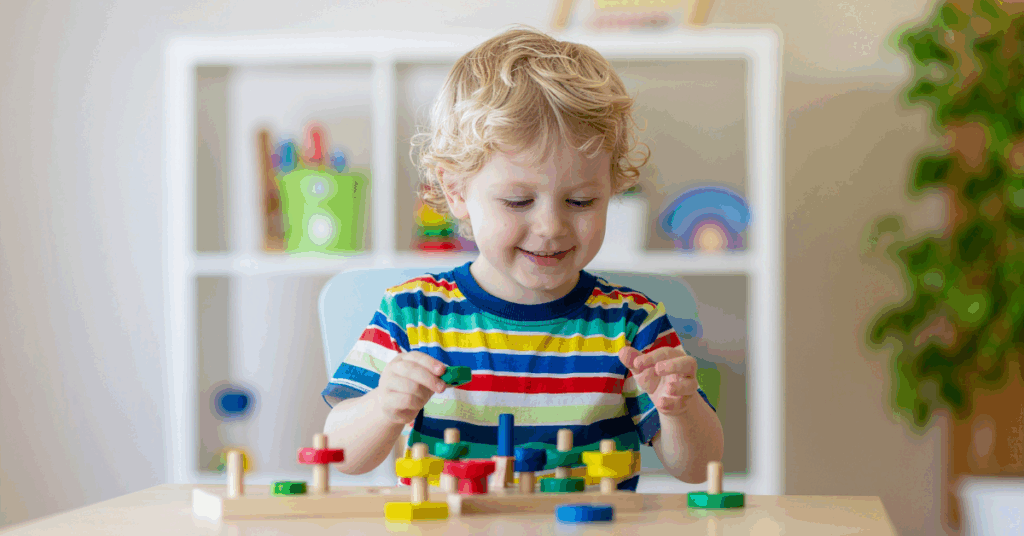
Blocks, scarves, figures, and loose parts can be used in endless ways. They don’t teach one skill — they support many: creativity, problem-solving, storytelling.
4. Real-World Relevance
Toys that reflect everyday life (kitchens, tools, dolls, animals) help children understand routines, relationships, and roles, supporting social-emotional and cognitive growth.
5. Skill Transfer
The best toys build abilities that go beyond the toy itself: perseverance, spatial reasoning, collaboration, and imagination.
Why Some Toys Entertain Without Teaching
Not every toy needs to be educational — but it helps to know why some don’t support learning.
Overstimulation
Flashing lights, loud sounds, and rapid movements can overwhelm a child’s nervous system, creating short bursts of excitement rather than sustained focus (AAP).
Passive Play
When a toy performs — talking, singing, lighting up — the child’s role becomes pressing a button. This limits creativity and problem-solving.
👉 https://dl.tufts.edu/concern/pdfs/6h440s418
Novelty Effects
Many toys rely on surprise. Once novelty fades, engagement fades too. Open-ended toys hold attention longer (NAEYC).
👉 https://www.naeyc.org/resources/pubs/yc/mar2018/what-research-says
Cognitive Overload
When a toy tries to teach too much at once, it can interfere with memory, attention, and enjoyment (Yadav et al., 2023).
Educational vs Entertaining: What the Research Shows
Across studies, consistent patterns emerge:
- Focus: Children focus longer on simple, open-ended toys than electronic ones.
- Creativity: Open-ended toys support richer imaginative play.
- Language: Children talk more and use more varied vocabulary with non-electronic toys.
- Independence: Child-led toys build confidence and self-directed learning.
- Problem-solving: Trial-and-error play strengthens cognitive flexibility and resilience.
Common Questions About “Educational” Toys
Let’s clear a few things up:
- Do toys with more buttons and features actually teach more?
Not always. In many cases, more features can mean less child-led play. The most learning-rich toys tend to invite your child to do something — like build, sort, pretend, or experiment — rather than press a button and watch. - Do electronic toys help children learn faster than simple toys?
Children usually learn best through interaction, repetition, and real play. Simple, open-ended toys often support longer focus and deeper thinking because the child is doing the work of the play. - Do talking toys really build language skills?
Talking toys can introduce words, but real conversation builds language most powerfully. Children develop vocabulary and communication through back-and-forth interaction with people, especially during play. - Are expensive toys always better for learning?
Not necessarily. Some of the most educational toys are simple, low-cost, or even everyday items. What matters most is whether the toy invites active, imaginative, and repeated play.
How to Choose Better Toys at Home
You don’t need expert training — just a few honest questions:
- Does this toy invite my child to do something, or just watch?
- Can it be used in more than one way?
- Does it encourage creativity, storytelling, or problem-solving?
- Is my child leading the play, or is the toy doing the work?
- Does it connect to real life — people, routines, feelings?
- Will it grow with my child?
If a toy keeps being returned to, used differently, and explored deeply — it’s doing meaningful developmental work.
Some Gentle Support
If you’d like a little support, I’ve created a few calm, parent-friendly resources:
- The Calm Play Guide — for screen-free, focused play at home
- Printable Learning Activities — low-prep, meaningful play
- Montessori Wall Art — visual routines that support independence
- 50-Page Activity Book — quiet, development-led activities for busy days
You can explore or download what feels helpful here → Free Resources
No pressure. Just support.
Further Reading & Resources
- American Academy of Pediatrics – The Power of Play https://publications.aap.org/pediatrics/article/142/3/e20182058/38649
- Harvard Center on the Developing Child – Executive Function https://developingchild.harvard.edu/science/key-concepts/executive-function/
- NAEYC – What Research Says About Toys and Play https://www.naeyc.org/resources/pubs/yc/mar2018/what-research-says
- Zero to Three – Choosing Toys for Toddlers https://www.zerotothree.org/resource/tips-on-choosing-toys-for-toddlers
- Tufts Digital Library – Educational Toys Review https://dl.tufts.edu/concern/pdfs/6h440s418
- ScienceDirect – Number of Toys & Toddler Play https://www.sciencedirect.com/science/article/abs/pii/S0163638317301613
- Yadav et al. (2023) – Educational Toy Design Review https://www.sciencedirect.com/science/article/pii/S2352146523000461
Closing Thoughts
If you’ve ever felt overwhelmed by toy labels, you’re not failing — you’re paying attention.
Here’s the quiet truth: educational toys aren’t about bells and whistles. They’re about how a toy invites your child to think, explore, and connect.
And sometimes, the most powerful learning happens with the simplest things — a cardboard box, a handful of blocks, a pretend tea party on the living-room floor.
Because in the end, it’s not about the toy.
It’s about the play.