What you’ll learn in this article…
- Simple ways to teach the alphabet at home without pressure or long sit-down sessions
- Why most alphabet learning methods don’t work (and what to do instead)
- Practical, real-life activities you can start using today to help your child recognise and write letters
I used to think teaching the alphabet at home meant sitting down, pointing at letters, and repeating them until something stuck.
A for apple.
B for ball.
Again and again.
But most of the time… it didn’t stick.
My child would lose interest within minutes, start fidgeting, or just walk off completely. And if I’m honest, it left me wondering whether I was doing something wrong.
If you’ve ever tried to teach the alphabet at home and felt like it just isn’t landing, join my club!
The problem usually isn’t your child.
It’s the way we’ve been taught to approach learning.
Why teaching the alphabet at home can feel so hard
When we think about alphabet learning, we often picture:
- Flashcards at the table
- Repeating letters out loud
- Trying to hold their attention for more than a few minutes
But toddlers and young children don’t learn best like that.
They don’t want to sit still.
They don’t want to be “taught” in a formal way.
And they definitely don’t respond well to pressure.
What they do respond to is:
- Movement
- Play
- Curiosity
- Repetition that doesn’t feel repetitive
Once I started shifting towards that, things improved.
A simpler way to teach the alphabet at home
What I’ve found is that teaching the alphabet at home works best when it feels like part of your day, not something separate.
You don’t need long sessions.
You don’t need perfect structure.
You just need small, consistent moments that build over time.
Here are a few simple ways to teach the alphabet at home that actually work in real life.
1. Start with recognition, not writing
It’s tempting to jump straight into tracing and writing.
But for most children, that’s too big of a step too soon.
Before they can write letters, they need to:
- Recognise them
- Notice differences between them
- Become familiar with their shapes
This can be as simple as:
- Pointing out letters on a poster
- Spotting letters on packaging
- Talking about letters during everyday moments
You’re building familiarity first.
That’s what makes everything else easier later.
2. Use repetition without making it feel repetitive
Children need repetition to learn.
But they don’t want to feel like they’re repeating something.
That’s where most approaches fall down.
Instead of repeating the same activity, you can:
- Look at the same letter in different ways
- Use different formats (poster, cards, play, tracing)
- Keep it short and relaxed
For example, the letter “A” might come up as:
- A poster on the wall
- A flashcard
- A tracing activity
- A quick “can you find something that starts with A?”
Same letter. Different experience.
3. Make it hands-on whenever possible
The more hands-on something is, the more likely a child is to engage with it.
Instead of only looking at letters, try:
- Tracing letters with fingers
- Drawing letters in the air
- Using playdough to form shapes
- Matching letters to objects
This is where learning really starts to click.
Because now they’re not just seeing letters — they’re interacting with them.
4. Keep it short and low-pressure
One of the biggest shifts for me was realising that:
More time doesn’t equal better learning.
In fact, shorter is usually better.
A few minutes here and there:
- At the table
- During play
- Before heading out
This builds consistency without resistance.
And resistance is what stops learning more than anything else.
5. Turn learning into something they want to come back to
This is the biggest one.
If learning feels like something they have to do, they’ll avoid it.
If it feels like something they want to do, they’ll come back to it.
That’s why simple games and playful prompts work so well.
Even something as basic as:
- “Can you find the letter B?”
- “What starts with M?”
- “Can you match this card?”
Turns learning into interaction.
Simple ways to teach the alphabet at home (free tracing sheets)
If you’re not sure where to begin, starting simple is always best.
I’ve put together a set of free alphabet tracing sheets that follow this same idea:
- Clear, simple letter forms
- Guided tracing to build confidence
- No clutter or overwhelm
You can use them for:
- Short daily practice
- Independent play
- Finger tracing before writing
You can download the free tracing sheets here:
If you want a complete alphabet learning setup
After using simple activities like these at home, I realised it helped to have everything in one place.
Not loads of different resources.
Just a few that worked together.
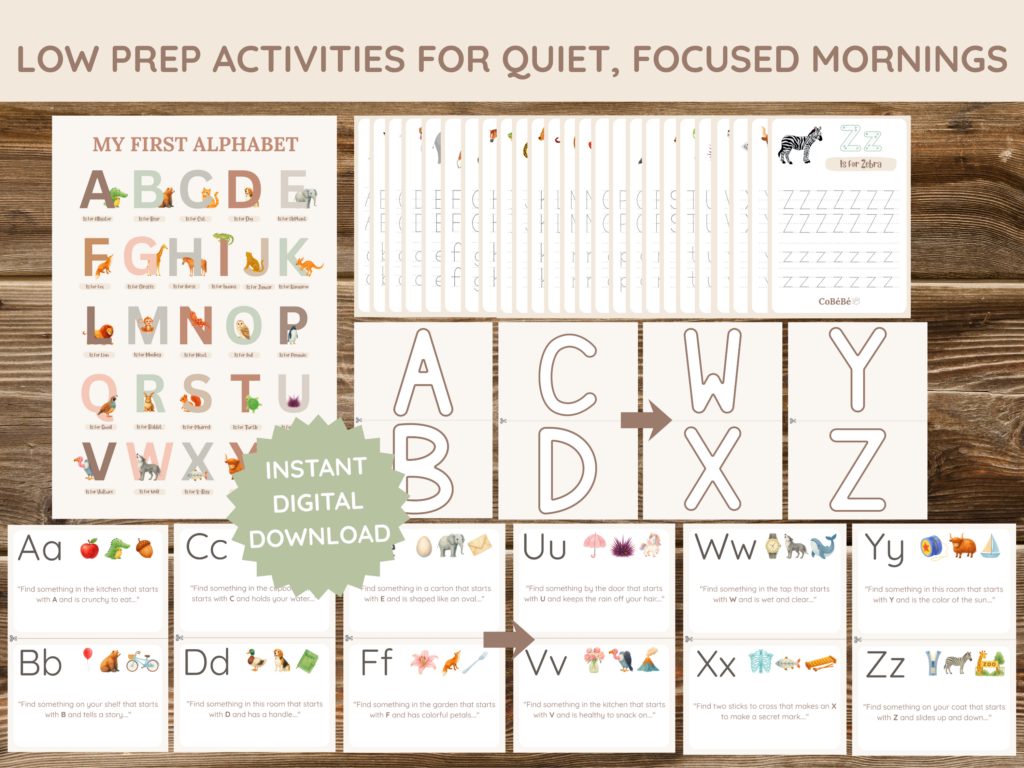
That’s what led me to create a full alphabet learning bundle that includes:
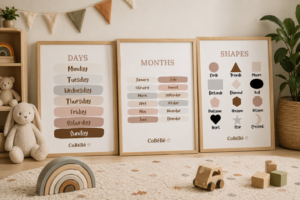
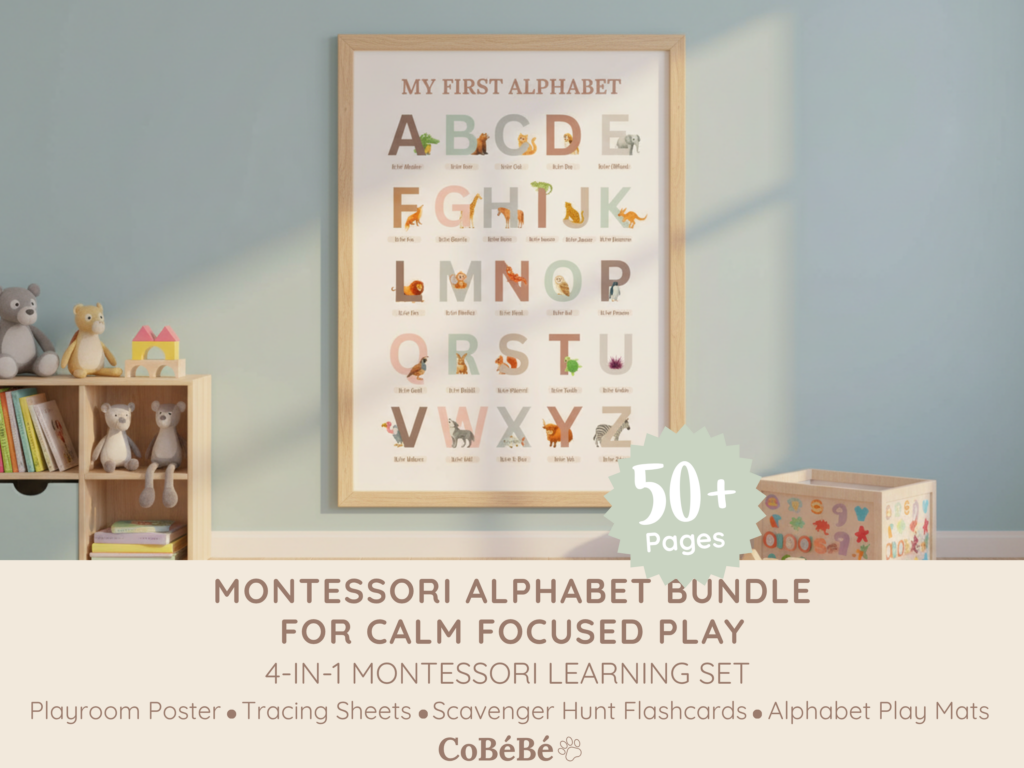
- A calm, visual alphabet poster for everyday exposure
- Tracing worksheets to support early writing
- Flashcards for recognition and simple games
- Play-based prompts to keep things engaging
It’s designed to follow the same approach:
Keep it simple
Keep it calm
Keep it consistent
You can see the full alphabet learning bundle here:
What matters most when teaching the alphabet at home
At the end of the day, teaching the alphabet at home isn’t about doing everything perfectly.
It’s about:
- Keeping things simple
- Reducing pressure
- Creating small moments of learning
Because those small moments add up.
And over time, you start to see:
- Recognition
- Confidence
- Curiosity
That’s when learning starts to feel natural — for both of you.
FAQ
What age should a child start learning the alphabet?
Most children start recognising letters between ages 2–4, but it varies. The key is keeping it relaxed and following their interest rather than forcing it.
How do I teach letter recognition at home?
The simplest way to teach letter recognition at home is through everyday exposure. Use posters, flashcards, and simple games to help your child notice and recognise letters naturally.
How long should alphabet learning sessions be?
Short sessions work best. Even 5–10 minutes at a time can be enough when done consistently without pressure.
Are tracing worksheets effective for toddlers?
Yes, when used in a simple, low-pressure way. Tracing helps build fine motor skills and familiarity with letter shapes, especially when combined with play-based learning.
What are the best alphabet activities for toddlers?
The best alphabet activities are hands-on and engaging, such as tracing, matching games, object recognition, and simple play-based prompts that don’t feel like formal learning.
Here’s What Else We Make…