A calm, realistic guide to choosing busy boxes that actually hold attention
What you’ll learn in this article
- What to look for in an activity box for toddlers that supports focus, independence and screen-free play.
- The science behind why some busy boxes hold attention while others are ignored.
- Simple ways to build or choose a toddler activity box that works in real life.
Where this article began…
The other afternoon we were waiting at the GP surgery.
One of those long waits where toddlers cycle through patience quickly.
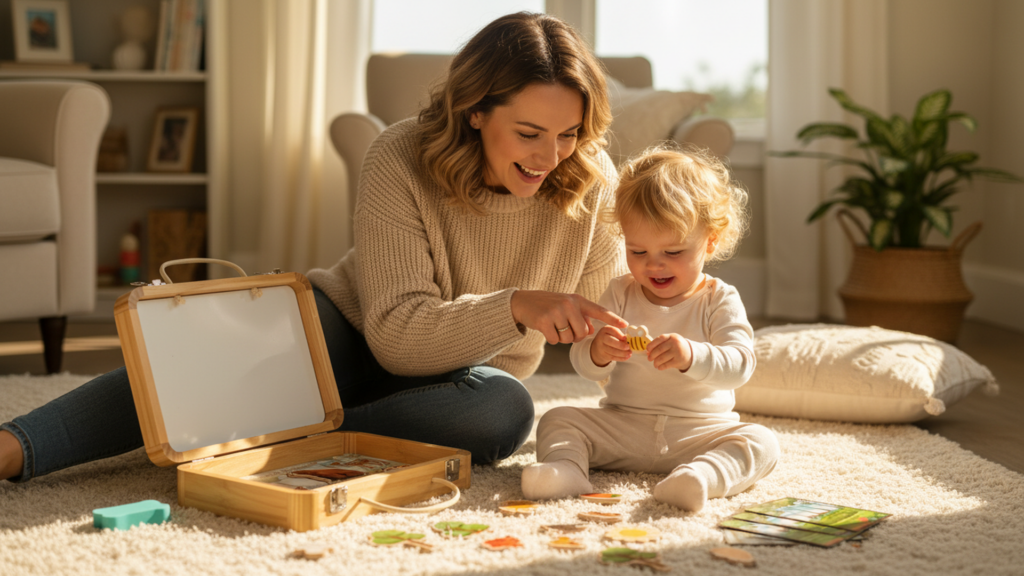
In the corner, a parent pulled out a small fabric pouch and tipped a few items onto the chair: a couple of wooden shapes, a spoon, a small tin, and some felt pieces. Nothing elaborate.
Their child stayed there. Sorting. Posting. Repeating.
Ten minutes passed. Then fifteen.
Across the room, another child moved between three different toys in the same time — each one exciting for a moment, then abandoned.
It wasn’t about “better” parenting or better toys.
It was about how the activity was presented.
That little pouch wasn’t full of entertainment.
It was full of possibility.
When toddlers are given a small, thoughtful selection of materials, they often settle into deeper play.
That’s where activity boxes come in.
Not as magic solutions — but as gentle invitations to focus, explore and play independently.
Let’s look at what actually makes a good one.
Why activity boxes are so popular with parents
Search “quiet time activities for toddlers” and you’ll quickly find activity boxes, busy boxes, or travel kits everywhere.
They’ve become a go-to for good reason.
For many families, they help with:
- independent play while a parent cooks or works
- reducing screen time
- calmer transitions before meals or bedtime
- travel and waiting rooms
- keeping mess contained
A curated box feels manageable for toddlers.
Not overwhelming. Just enough.
As described in this guide from Hands On As We Grow, a simple activity box can feel like “an invitation to play” rather than a toy overload.
The science behind what holds a toddler’s attention
Short attention spans are normal
Most toddlers can focus for roughly 3–6 minutes per year of age.
So a 3-year-old might stay engaged for around 9–18 minutes.
But when an activity is open-ended and hands-on, they often stay longer.
https://www.canr.msu.edu/news/toddler_attention_spans
Fewer materials = deeper play
A study published in Infant Behavior and Development found toddlers played more creatively and for longer when given fewer toys.
https://pubmed.ncbi.nlm.nih.gov/29219355
Too many options can overwhelm.
A small selection supports focus.
Hands-on play builds brain connections
When toddlers scoop, sort, post, stack and repeat, they’re strengthening neural pathways for:
- motor skills
- problem-solving
- language
- attention
The Harvard Center on the Developing Child highlights that active, hands-on experiences build strong brain architecture.
https://developingchild.harvard.edu
Repetition is learning
That endless pouring, posting and lining up?
It’s called schema play.
Repetition helps toddlers understand cause and effect and build mastery.
Montessori approaches refer to this as “work” because it’s purposeful and focused.
What makes a good activity box for toddlers
After a lot of trial, error, and stepping on rogue pom-poms, here’s what matters most.
1. Open-ended materials
Look for items that can be used in many ways:
- wooden coins
- felt shapes
- stacking items
- posting games
Avoid one-use activities with only one “right” outcome.
2. Safe and durable
Toddlers test everything.
Choose materials that are:
- sturdy
- non-toxic
- safe if mouthed
- appropriate for age
NHS choking guidance is useful here:
3. Small and portable
A good activity box isn’t huge.
Home use: shoebox size
Travel use: pouch or small container
Too big = rarely used.
4. Fewer pieces
More items often reduce engagement.
A small, focused set helps toddlers settle into play.
5. Grows with the child
Look for flexible items:
- wooden discs
- sorting pieces
- scoops
- threading items
These can evolve with age.
6. Supports independent play
Some activities need adult help.
But a good busy box should also work while you sit nearby.
Even ten minutes matters.
Common mistakes parents make
Too many items
Creates overwhelm and messy clean-up.
Too complicated
If instructions are needed, toddlers often lose interest.
Too noisy
Flashing lights and sounds can reduce focus.
Quickly outgrown
Choose materials with replay value.
Looks good but lacks depth
Some subscription boxes are beautiful but single-use.
Look for reuse and imagination.
How to make a simple activity box at home
You don’t need to spend much.
Some of the best items come from drawers and recycling.
Household ideas
- muffin tin + pom-poms
- spice jars + cotton buds
- ribbons in a wipes box
- lids and pegs
Sensory ideas
- dry rice or pasta tub
- scoops and cups
- felt shapes
Prompt cards
- sort by colour
- build a tower
- find something soft
Keep it accessible.
Even ten minutes before tea can work.
What I’ve learned from using activity boxes
Activity boxes aren’t really about keeping toddlers busy.
They’re about giving them a manageable space to explore.
When the materials are simple and repeatable, something shifts:
- they stay longer
- they repeat actions
- they concentrate
- they lead the play
And when they’re engaged like that, you feel it too.
The house gets a little calmer.
Looking for calm, focused play ideas?
If you’re building a quiet time box or trying to create more independent play at home, I’ve put together a free Calm Play Guide with simple ideas you can use straight away.
At the same time, I’ve been working in the background on something new — a nature-themed activity puzzle called Forest Friends, designed to bring together everything we’ve talked about in this article: open-ended materials, gentle prompts, and screen-free play that actually holds a child’s attention.
It’s not quite ready yet. But it’s coming.
You can download the Calm Play Guide below for now, and that will enable you to receive updates to hear when Forest Friends launches, you’re very welcome to join the list. You’ll also have access to 100+ free printable resources.
→ Download the Calm Play Guide
FAQ: Activity boxes for toddlers
What age are activity boxes for?
Usually from 18 months to around 5 years, depending on contents.
How many items should be in a busy box?
Around 4–8 items is plenty.
How long should toddlers use one?
Even 10–20 minutes of focused play is valuable.
Should activity boxes replace toys?
No. They complement them by offering calmer, focused play.
Can I rotate activity boxes?
Yes — rotating keeps interest high without overwhelm.
What other names are there for an activity box for toddlers?
You might hear activity boxes called a few different things depending on where you’re looking. Common names include busy boxes, quiet time boxes, travel activity kits, busy bags, or even Montessori work boxes.
When searching online, trying a few of these terms can help you find more ideas and inspiration for creating your own.
Closing thoughts
Activity boxes don’t need to be elaborate.
They just need to be intentional.
When toddlers are given a small, thoughtful selection of materials, something shifts.
They slow down.
They repeat.
They focus.
And in those moments, you see what play really is:
not distraction, but discovery.
Sometimes all it takes is a small box — and a little space to explore.
Sources
Hands On As We Grow
Harvard Center on the Developing Child
https://developingchild.harvard.edu
Infant Behavior and Development study
https://pubmed.ncbi.nlm.nih.gov/29219355
Michigan State University Extension
Zero to Three
Montessori UK